Skip to content



Keeping soy milk fresh, safe, and nutritious starts with understanding its shelf life under different storage conditions. Whether you buy refrigerated cartons, shelf-stable soy milk, or prepare homemade batches, knowing exactly how long soy milk lasts can help prevent food waste while protecting your family from consuming spoiled beverages.
In this complete shelf life guide, you’ll learn how long soy milk lasts in the refrigerator, freezer, pantry, and at room temperature. We’ll also explain how long unopened and opened soy milk remains safe, what happens after the expiration date, how to store soy milk while traveling, and the most reliable signs that indicate soy milk has gone bad.
Quick Summary
- The exact shelf life of unopened and opened commercial soy milk.
- How long homemade soy milk stays fresh and how to store it safely.
- Refrigerator, freezer, pantry, and room-temperature storage timelines.
- The most reliable signs that soy milk has spoiled and should be discarded.
- Practical food safety tips to help reduce waste and keep every carton fresh for as long as possible.
👉 While this guide focuses on soy milk storage and shelf-life safety, many readers also explore traditional dairy safety timelines, such as how long does raw milk last to better understand storage risks across different milk types.
Complete Timelines: How Long Does Soy Milk Last?
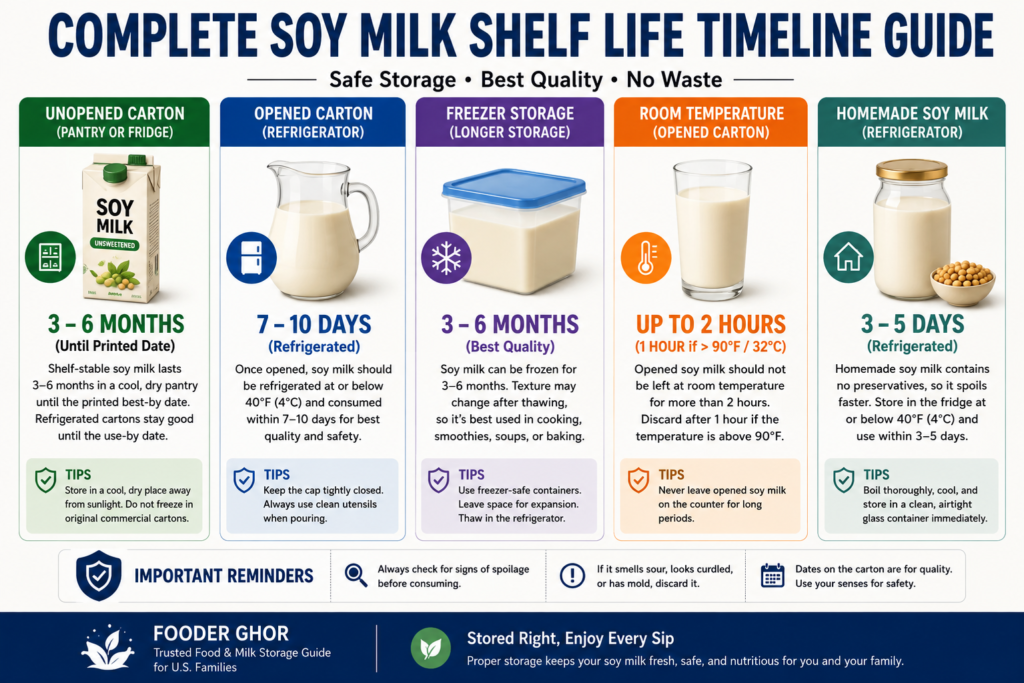
Commercial soy milk can last anywhere from 2 hours to 6 months, depending on how it is stored. Opened cartons typically stay fresh for 7 to 10 days in the refrigerator, while unopened shelf-stable soy milk can remain in the pantry for 3 to 6 months. Homemade soy milk has the shortest shelf life and should usually be consumed within 3 to 5 days.
The quick reference chart below summarizes the recommended storage times for the most common types of soy milk. The storage recommendations are based on USDA food safety guidance and standard commercial storage practices.
| Soy Milk Type | Unopened Shelf Life | Opened Shelf Life |
|---|---|---|
| Refrigerated Commercial Soy Milk | Until the printed use-by date (Keep Refrigerated) | 7–10 Days (Refrigerated) |
| Shelf-Stable Soy Milk | 3–6 Months in a cool, dry pantry (or until the printed best-by date) | 7–10 Days (Refrigerated) |
| Homemade Soy Milk | Refrigerate immediately after preparation | 3–5 Days (Refrigerated) |
| Frozen Soy Milk | Not recommended to freeze unopened cartons | 3–6 Months (Best Quality) |
| Silk Soy Milk (All Varieties) | Until the printed expiration date | 7–10 Days (Refrigerated) |
| Chocolate Soy Milk | Until the printed expiration date | 7–10 Days (Refrigerated) |
| Soy Milk at Room Temperature | Shelf-stable cartons: Until the printed best-by date | 2 Hours (or 1 Hour above 90°F / 32°C) |
| Soy Milk Left Out Overnight | — | Discard Immediately |
While soy milk follows a fairly standard refrigeration timeline, other plant-based milks like almond milk have slightly different storage durations depending on whether they are homemade or commercially processed, such as how long does almond milk last.
How Long Does Soy Milk Last in the Fridge?
Soy milk lasts for 7 to 10 days in the refrigerator after opening when kept at or below 40°F (4°C). Unopened refrigerated soy milk remains safe until its printed use by date, while unopened shelf stable soy milk should stay in the pantry until opened rather than being refrigerated for long term storage.
Many families assume that refrigeration automatically extends the life of every carton of soy milk. In reality, shelf life depends on whether the soy milk is sold as a refrigerated product or an aseptically packaged shelf stable carton, and whether the package has been opened. Once the seal is broken, exposure to air and bacteria significantly shortens its usable life, even under refrigeration.
For the best results, proper storage matters just as much as refrigeration. Read our complete guide on how to store soy milk safely to learn the best storage practices for maximum freshness and shelf life.
Unopened in the Fridge
Unopened refrigerated soy milk lasts until its printed use-by date when continuously stored in the refrigerator at 40°F (4°C) or below. In contrast, unopened shelf-stable soy milk does not gain extra shelf life from refrigeration and is best stored in a cool, dry pantry until opened.
Commercial refrigerated soy milk is continuously kept cold throughout manufacturing, transportation, and retail storage. As long as the carton remains unopened and properly refrigerated, it should remain safe until the manufacturer’s use by date.
Shelf-stable soy milk is different. It is processed using ultra-high temperature (UHT) treatment and sealed in aseptic packaging, allowing it to remain safe at room temperature before opening. Refrigerating an unopened shelf-stable carton is not harmful, but it generally does not extend its shelf life beyond the printed date because the product is already designed for pantry storage.
According to the U.S. Food and Drug Administration (FDA), shelf-stable foods packaged aseptically can be safely stored at room temperature until opened, after which they must be refrigerated promptly.
If you are checking an older carton, always inspect the package before opening. A swollen carton, leaking seams, or unusual damage may indicate contamination, and the soy milk should be discarded regardless of the printed date. If you want to prepare soy milk at home, read our guide on how to make soy milk from powder for a simple method and practical tips.
Opened in the Fridge
Opened commercial soy milk lasts for 7 to 10 days in the refrigerator when continuously stored at or below 40°F (4°C). Unopened refrigerated soy milk remains safe until its printed use-by date, while unopened shelf-stable soy milk should stay in a cool pantry until opened.
The moment a soy milk carton is opened, its sterile environment is lost. Air, utensils, and repeated pouring introduce microorganisms that gradually reduce both safety and freshness. Even though refrigeration slows bacterial growth, it does not stop it completely.
The U.S. Department of Agriculture (USDA) recommends keeping perishable foods refrigerated at 40°F (4°C) or below because bacteria multiply rapidly within the temperature danger zone. For this reason, opened soy milk should never be left unrefrigerated for extended periods and should be consumed within the recommended 7 to 10-day window.
Although soy milk may naturally separate during storage, separation alone is not a sign of spoilage. However, if you notice a sour smell, curdled texture, mold, or an unusually swollen carton, discard the product immediately.
If you regularly keep both dairy and plant-based milk at home, compare these storage timelines with our guide on how long does cow milk last to organize your family’s refrigerator more effectively.
How Long Does Soy Milk Last in the Freezer?
Soy milk lasts for 3 to 6 months in the freezer when stored at 0°F (-18°C) or below. Although freezing keeps soy milk safe for several months, it often changes the texture after thawing, causing the liquid to separate or become slightly grainy.
Freezing is a practical way to reduce food waste if you cannot finish an opened carton before it expires. Low temperatures stop the growth of spoilage bacteria, allowing soy milk to remain safe for much longer than refrigeration. However, freezing does not preserve the product’s original texture. During thawing, the proteins and fats naturally separate, which may affect its smooth consistency.
While previously frozen soy milk may not be ideal for drinking because of its altered texture, it remains an excellent choice for smoothies, soups, sauces, oatmeal, and baking recipes.
According to the U.S. Food and Drug Administration (FDA), frozen foods remain safe indefinitely when kept continuously at 0°F (-18°C) or below, although quality gradually declines over time. For the best flavor and texture, consume frozen soy milk within 3 to 6 months.
If you regularly freeze dairy products as well, compare these storage recommendations with our guide on can you freeze evaporated milk to understand how freezing affects different types of milk.
How Long Does Homemade Soy Milk Last?
Homemade soy milk lasts for 3 to 5 days in the refrigerator when stored in a clean, airtight container at or below 40°F (4°C). Because it contains no commercial preservatives or aseptic packaging, homemade soy milk spoils much faster than unopened store-bought varieties and should never be left at room temperature for more than 2 hours.
Fresh homemade soy milk has a significantly shorter shelf life because it is prepared in a home kitchen rather than under sterile commercial processing conditions. During soaking, blending, straining, and boiling, the milk is naturally exposed to air, utensils, and environmental microorganisms. Although boiling helps reduce bacteria, it does not create the same sterile environment achieved through ultra-high temperature (UHT) processing and aseptic packaging used for many commercial soy milk products.
If you plan to prepare fresh batches regularly, read our complete guide on how to make oat milk for step-by-step instructions and the best practices to improve freshness from the start.
How Long Does Soy Milk Last at Room Temperature?
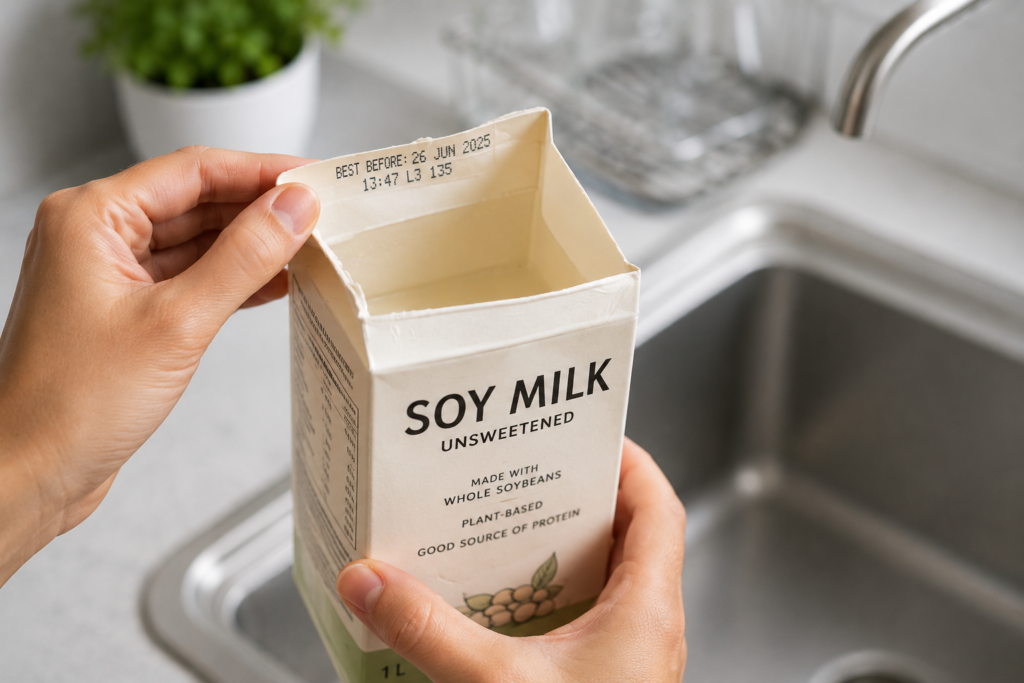
Commercial soy milk lasts for different lengths of time at room temperature depending on whether the carton has been opened. Unopened shelf-stable soy milk can remain safely stored in a cool, dry pantry until its printed best-by date, while opened soy milk should never sit at room temperature for more than 2 hours, or 1 hour if the temperature is above 90°F (32°C).
Many consumers assume that all soy milk can safely remain on the kitchen counter because some cartons are sold without refrigeration. In reality, the safe storage time depends entirely on whether the product is a sealed shelf-stable carton or an opened container that has been exposed to air.
Unopened at Room Temperature
Unopened shelf-stable commercial soy milk can safely remain at room temperature until its printed best-by date when stored in a cool, dry place away from direct sunlight. However, unopened refrigerated soy milk should never be stored at room temperature because it requires continuous refrigeration from production through purchase.
Shelf-stable soy milk is manufactured using ultra-high temperature (UHT) processing and sealed in aseptic cartons that prevent microbial contamination. This specialized packaging allows the product to remain shelf stable without refrigeration until the original factory seal is broken.
👉 To understand home boiling methods for safety, read our step-by-step guide on how to make soy milk.
Opened at Room Temperature
Opened commercial soy milk should not remain at room temperature for more than 2 hours. If the surrounding temperature exceeds 90°F (32°C), it should be discarded after just 1 hour.
Once the factory seal is broken, soy milk is exposed to airborne microorganisms and can no longer be considered shelf stable. Harmful bacteria multiply rapidly when perishable foods remain within the temperature danger zone between 40°F and 140°F (4°C to 60°C). Even if the soy milk looks normal or smells fine, prolonged exposure to room temperature may make it unsafe to consume.
According to the U.S. Department of Agriculture (USDA), perishable foods should never remain in the temperature danger zone for more than 2 hours, or 1 hour when the ambient temperature is above 90°F (32°C). To help maintain both safety and quality, discard any opened soy milk that has been left on the counter longer than these recommended limits.
👉 For similar safety rules regarding perishable dairy left on the counter, review our guide on how long does breast milk last.
How Long Can Soy Milk Last After Expiration Date?
Unopened shelf-stable soy milk may remain safe for roughly 1 to 4 weeks after its printed best-by date, depending on the brand and storage conditions, if the carton has been stored properly, remains completely sealed, and shows no signs of damage and remains completely sealed and undamaged. Unopened refrigerated soy milk may also stay safe for a short period past its use-by date if it has been continuously refrigerated, but it should always be inspected carefully before consumption.
The printed date on a soy milk carton is primarily a guideline for peak quality rather than an exact safety deadline. When commercial soy milk is stored under the recommended conditions, it may remain usable beyond the printed date, although its flavor, texture, and nutritional quality can gradually decline over time.
Before drinking expired soy milk, always inspect the carton carefully. Discard the product immediately if you notice any of the following signs:
- Swollen or bloated carton, indicating possible gas-producing bacterial growth.
- Leaking or damaged packaging that may have allowed contamination.
- Sour or unpleasant odor after opening.
- Curdled texture, unusual lumps, or excessive separation that does not mix after shaking.
- Visible mold or discoloration inside the carton.
If the packaging is intact and the soy milk looks, smells, and tastes normal, it may still be safe for a short period after the printed date. However, when there is any doubt about its freshness or safety, it is always best to discard the carton rather than risk foodborne illness.
For another popular dairy-free alternative, see our guide on how long does rice milk last to compare expiration timelines and proper storage practices.
How Long Does Soy Milk Last While Traveling?
Unopened shelf-stable soy milk can last throughout your trip without refrigeration until its printed best-by date, provided the carton remains sealed and is protected from excessive heat and direct sunlight. Once opened, commercial soy milk should be kept below 40°F (4°C) in an insulated cooler and should never remain unrefrigerated for more than 2 hours, or 1 hour if the temperature exceeds 90°F (32°C).
Whether soy milk stays fresh while traveling depends on the type of product and how it is transported. Shelf-stable soy milk is specially processed using ultra-high temperature (UHT) treatment and aseptic packaging, making it ideal for road trips, camping, flights, lunch boxes, and emergency food supplies before opening.
Once the factory seal has been broken, however, soy milk becomes a perishable beverage that must be kept cold during transport. If you’re carrying opened soy milk for several hours, store it in a well-insulated cooler with sufficient ice packs to help maintain a safe temperature. Avoid leaving the carton inside a parked vehicle or in direct sunlight, as high temperatures can quickly accelerate bacterial growth and reduce both safety and quality.
For the safest travel experience, pack only the amount of soy milk you expect to use and discard any leftovers that have exceeded the recommended unrefrigerated time. For more information on storage time and freshness, read our guide on how long does evaporated milk last to learn how long it stays usable under different storage conditions.
How Long Does Soy Milk Last If Left Out Overnight?
Soy milk that has been left out overnight should be discarded immediately. Once opened, commercial soy milk is no longer safe to drink after remaining at room temperature overnight, even if it still looks, smells, or tastes normal.
After the original seal is broken, soy milk is exposed to air and naturally occurring bacteria. Leaving it on the kitchen counter overnight allows harmful microorganisms to multiply rapidly, especially when the beverage remains within the temperature danger zone for several hours. Although plant-based milk does not spoil in exactly the same way as dairy milk, it can still develop unsafe levels of bacterial contamination when left unrefrigerated for too long.
Many people believe they can judge soy milk by its appearance or smell alone, but spoilage is not always visible. A carton may appear perfectly normal while still containing harmful bacteria that can cause foodborne illness. Likewise, reheating or boiling soy milk after it has been left out overnight will not reliably restore its safety.
Whenever soy milk has remained at room temperature overnight, the safest choice is to throw it away and open a fresh carton rather than risk consuming a potentially contaminated product. Once you open a fresh carton, be sure to read our guide on soy milk health benefits to discover the nutritional advantages of properly stored soy milk.
How Long Does Silk Soy Milk Last?
Just like any other commercial brand, the shelf life of Silk soy milk depends entirely on whether it is shelf-stable or refrigerated, and if the carton has been opened.
Here is the exact breakdown for Silk soy milk:
- Unopened (Shelf-Stable): If you purchased Silk soy milk from the regular grocery shelves (Tetra Pak), it will last in your pantry for 3 to 6 months until the printed expiration date, and may remain safe for a short period past the printed date if the carton remains unopened, undamaged, and properly stored, although quality gradually declines.
- Unopened (Refrigerated): If you bought Silk soy milk from the cold dairy aisle, it must go straight into your fridge. It will remain fresh until the printed expiration date. Silk does not officially guarantee freshness beyond this date. Inspect the carton carefully (check for swelling, off smell, or curdling) before use if consuming past the printed date.
- Once Opened (7 to 10 Days): The moment you break the seal on any carton of Silk soy milk (plain, vanilla, or chocolate), the countdown begins. It must be stored in the refrigerator and consumed within 7 to 10 days.
If you regularly drink soy milk, explore our guide on the benefits of soy milk for skin to discover how soy’s nutrients may help support healthy skin.
Flavor Variations: How Long Does Chocolate Soy Milk Last?
Flavored commercial plant milks follow the exact same storage timelines as standard plain or vanilla varieties, lasting 7 to 10 days after opening. Many families use this sweet option for children’s snacks, meaning keeping track of the opening date is highly important for family safety. The added cocoa powder, natural sweeteners, and flavorings inside chocolate soy milk do not extend or shorten its biological shelf life in the refrigerator.
It is also worth noting that the thick consistency of chocolate varieties can sometimes mask early visual signs of spoilage, such as mild separation. For this reason, Always check for multiple signs of spoilage, including a sour odor, curdling, mold, excessive separation that does not mix after shaking, or an unusually swollen carton before consuming flavored soy milk. If the sweet cocoa aroma takes on a sharp, vinegary, or sour note, the liquid has gone bad and must be discarded immediately.
👉 While flavored soy milk follows the same general storage timeline as plain varieties, it is also important to understand possible sensitivities and digestive considerations associated with plant-based milk consumption, such as coconut milk side effect in certain individuals.
Does Soy Milk Go Bad? (How to Tell If Soy Milk Is Spoiled)
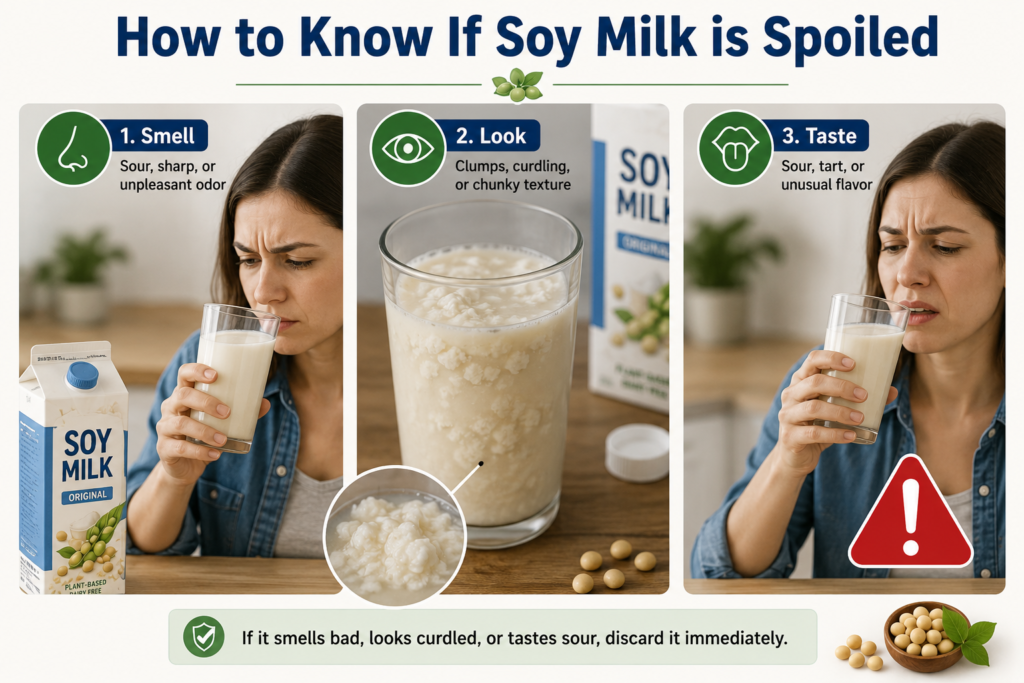
Yes, soy milk absolutely goes bad. While it lasts longer than dairy milk, it will eventually spoil due to bacterial growth once exposed to air or kept past its prime.
To protect your health, you should never drink spoiled soy milk. Always use your senses and look out for these three clear signs of spoilage before pouring a glass:
- The Sniff Test (Sour Smell): Fresh soy milk has a very mild, nutty, and slightly sweet aroma. If you open the carton and notice a sharp, sour, vinegary, or yeast-like smell, it has gone bad and should be discarded.
- The Visual Test (Clumps and Curdling): Pour a small amount of the milk into a clear glass. If you see heavy clumping, floating chunks, or a texture that looks like curdled yogurt, the milk has spoiled. Note: Homemade soy milk or plant-based milks may naturally separate over time, but will blend smoothly again after shaking. Additionally, pouring fresh soy milk into highly acidic hot coffee or tea can sometimes cause harmless curdling due to thermal and acidity changes. However, if cold soy milk is already chunky or curdled on its own inside the carton, it is spoiled and should be discarded immediately.
- The Taste Test (Sour or Tart Flavor): Only consider tasting soy milk if it has already passed both the smell and visual inspection. If it has any sour or unusual flavor, discard it immediately.
According to the U.S. Department of Agriculture (USDA), perishable foods that develop unusual odors, textures, or visible signs of spoilage should be discarded immediately to reduce the risk of foodborne illness. Never rely on appearance alone when determining whether soy milk is still safe to drink.
If you’re curious about what makes soy milk a nutritious choice when it’s fresh and properly stored, explore our complete guide on soy milk nutrition facts to learn about its protein, vitamins, minerals, and overall nutritional value.
Soy Milk Normal Changes vs. Spoilage: What’s the Difference?
Yes, there is an important food safety distinction between harmless physical shifts in stored soy milk and actual bacterial spoilage:
Harmless Physical Shifts (Safe to Drink):
- Natural Separation: Homemade or additive-free commercial soy milk naturally separates into a watery layer and dense soy solids after standing cold. This is completely safe and is not spoilage; a gentle shake restores its smooth, creamy liquid texture.
- Curdling in Hot Coffee: Fresh soy milk can sometimes curdle or split when poured into hot, acidic coffee due to sudden temperature and acidity changes (thermal shock). If the cold soy milk was smooth inside the carton before pouring, this curdling is a harmless physical reaction.
- Sediment at the Bottom: Small particles of soy protein or added minerals (like calcium) settling at the bottom of the carton are normal physical shifts and do not indicate bacterial activity.
Actual Spoilage Signs (Unsafe – Discard Immediately):
- Thick Curdling and Lumps: Soy milk that pours out in sour, thick chunks, has curdled on its own inside the carton, or develops a slimy texture has undergone active bacterial breakdown and must be thrown away.
- Sharp Sour Odor: A pungent, vinegary, acidic, or fermented smell replacing the mild, nutty aroma indicates rapid bacterial growth.
- Swollen Carton or Mold: A bloated, puffed-up package indicates gas production from active spoilage bacteria inside. Visible mold along the spout or rim also confirms microbial contamination.
For a helpful comparison of the flavor, nutrition, and everyday uses of soy milk and coconut milk, check out Soy Milk vs Coconut Milk for a detailed guide.
What Happens If You Drink Spoiled Soy Milk?
Drinking spoiled soy milk introduces harmful bacteria into your system, which can cause food poisoning, stomach cramps, and nausea. If you accidentally consume it, make sure to stay hydrated. For a complete list of symptoms and safety guidelines, check out our detailed guide on the side effects of drinking soy milk.
Note: While food poisoning comes from spoiled milk, drinking fresh soy milk in excessive amounts can also trigger distinct digestive sensitivities or allergic reactions in certain individuals.
Why Trust Fooder Ghor?
At Fooder Ghor, we provide comprehensive, research-backed educational resources on all types of milk including breast milk, dairy (cow, goat, camel, sheep, buffalo), and plant-based alternatives (oat, soy, almond). Our guides cover everything from nutrition, taste, and health benefits to proper storage, shelf life, and safety handling, aligned with official guidance from the CDC, FDA, USDA, and AAP. To maintain the highest standards of scientific accuracy, this article has been medically reviewed by a Public Health Expert (MPH). This content is for educational purposes only and does not substitute for professional medical advice.
Most Common Frequently Asked Questions
No, raw or unheated homemade soy milk should never be consumed. Raw soybeans contain natural antinutrients (like trypsin inhibitors) and potential harmful bacteria that can cause severe digestive distress. Homemade soy milk must always be thoroughly boiled for at least 15 to 20 minutes during preparation to destroy heat-sensitive toxins and bacteria before cooling, refrigerating, and consuming within 3 to 5 days.
Freezing breaks the molecular bond between the plant fats and water, which is completely normal; blending the liquid on high speed will help restore smoothness.
No, a swollen carton indicates intense gas production from active bacterial spoilage inside, and the product must be discarded without tasting.
No, both organic and conventional commercial options share the exact same 7 to 10 day refrigerator shelf life once the sterile seal is broken.
Conclusion
So, how long does soy milk last? It depends heavily on the production type and storage setup. Opened commercial cartons and popular brands like Silk will remain fresh for 7 to 10 days in the fridge, while fresh homemade batches must be used within 3 to 5 days. Never leave your plant milks at room temperature for more than 2 hours, and remember that frozen soy milk is best used in smoothies, soups, sauces, oatmeal, and baking because freezing may change its texture. Following these simple guidelines ensures your kitchen staples stay reliable and safe.
👉 If you are curious about the shelf life of other popular plant milks, read our detailed guide on how long does oat milk last after opening.