Skip to content

For parents across the U.S., one of the most common questions after pumping is, “How long does pumped breast milk last?” Understanding exactly how long breast milk lasts under different conditions helps you store it safely, keeping your milk nutrient-rich, fresh, and waste-free. This guide breaks down how long bottled breast milk lasts at room temperature, in the fridge, and in the freezer, and provides quick, actionable answers to every major storage question parents face.
What You Will Learn in This Guide
- The official CDC time limits for breast milk at room temperature, fridge, and freezer
- How long thawed or defrosted breast milk remain safe to use
- The critical 2-hour rule for warmed or leftover milk (including reheated milk)
- Essential safety tips to avoid common storage mistakes in your US kitchen
- Quick answers to FAQs about milk safety after birth and in a cooler
Storage Time Guide: The Official CDC Safety Guidelines
According to the CDC breast milk safety guidelines (Centers for Disease Control and Prevention) are as follows:
Room Temperature Storage: How Long Does Breast Milk Last Outside?
Freshly expressed breast milk can stay at room temperature for a limited time when handled properly. General considerations include:
- Room temperature level
- Whether milk is freshly pumped or already warmed
- Whether baby has already started feeding
Because storage limits vary depending on milk condition and temperature, parents should always follow safe timing practices. For a complete breakdown of exact room temperature safety rules, read our detailed guide on How Long Can Breast Milk Stay at Room Temperature?
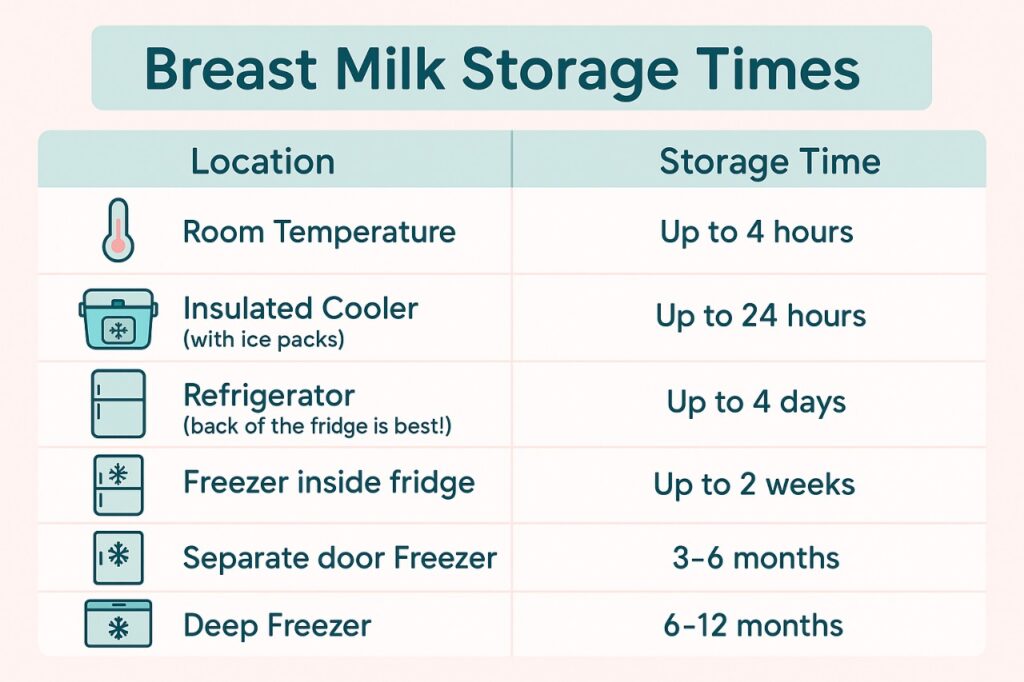
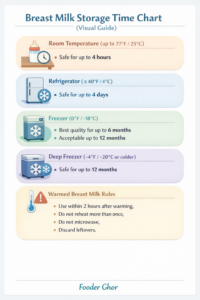
Breast Milk Storage Time Chart (Visual Guide)
How Long Is Breast Milk Good For?
Many new parents ask, how long is breast milk good for? In general, freshly pumped breast milk is good for up to 4 hours at room temperature, 4 days in the refrigerator, and up to 12 months in the freezer, according to CDC guidelines.
Refrigerator Storage: How Long is Breast Milk Good in the Fridge?
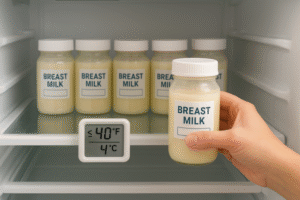
Refrigeration is one of the most common ways parents store freshly pumped breast milk for short-term use. According to the Centers for Disease Control and Prevention (CDC), proper refrigeration helps slow bacterial growth and preserve milk quality before feeding or freezing.
Best practices usually include:
- Keeping milk cold consistently
- Using sealed food-safe containers
- Storing milk toward the back of the refrigerator
- Labeling containers clearly for easier milk rotation
Proper fridge storage helps maintain milk freshness while reducing unnecessary waste and contamination risk.
Proper fridge storage helps maintain milk quality before feeding or freezing. For exact refrigeration timelines, storage duration, and safety rules, read our full guide on How Long Does Breast Milk Last in a Deep Freezer?
Freezing & Thawing: Long-Term Storage Essentials
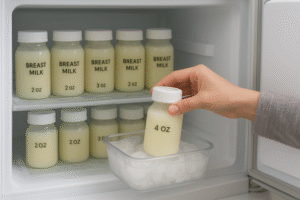
Freezing supports longer-term milk storage planning for parents building extra supply. Exact freezer duration, thawing methods, and post-thaw handling depend on milk condition and storage setup.
For complete freezer organization, storage methods, and pumping workflow tips, read our Detailed Breast Milk Storage Guidelines.
Storage Optimization: How you freeze your milk matters as much as how long you store it. To save 50% more space and ensure even freezing, most U.S. moms prefer freezing milk flat.
Learn the step-by-step process in our specialized guide: How to Freeze Breast Milk Flat for Space Saving.
Warming & Reheating: How Long Does Breast Milk Last Once Heated?
Once breast milk is warmed, its storage flexibility becomes much more limited.
Important factors include:
- Whether milk was freshly warmed or previously refrigerated
- How long milk stays at room temperature after warming
- Whether baby has already fed from the bottle
Parents should be more cautious after warming because temperature changes can affect milk safety.
For complete warming rules, reheating guidance, and safety timelines, read How Long Does Breast Milk Last After Warming.
Cleaning, Labeling & Handling Tips
Safe milk storage starts with proper handling habits.
Helpful practices include:
- Washing hands before pumping or handling milk
- Using clean storage containers
- Labeling milk with date and time
- Storing milk promptly after expression
Strong storage habits help parents stay organized and reduce milk waste.
For complete milk handling, freezing, organization, and storage methods, read our Breast Milk Storage Guidelines.
👉 According to the Centers for Disease Control and Prevention, proper hygiene, rapid cooling, and safe storage practices are essential to prevent bacterial growth and maintain breast milk quality.
Why Trust Fooder Ghor?
At Fooder Ghor, we provide educational resources focused on understanding the safe use, handling, and storage of different types of milk, including breast milk, cow’s milk, goat milk, and raw milk, based on publicly available guidance from trusted sources such as the CDC, FDA, USDA, and AAP. Some milk-related articles, particularly those involving maternal and infant feeding topics, are reviewed for clarity and presentation by nursing students with academic training in maternal and child health to help make information easier to understand. This content is provided for learning purposes only and does not offer medical advice.
Most Common Questions
A: Discard any milk leftover in the bottle (after the baby has started drinking) after 2 hours due to bacterial contamination.
A: In a properly packed insulated cooler bag with ice packs, milk can remain safe for up to 24 hours.
A: Colostrum follows the same storage rules as mature breast milk.
A: Yes, but freshly pumped milk should be cooled before combining with already chilled milk for safer storage consistency.
A: Milk that remains in the breast is best used at the next feed; storage times apply once expressed.
A: Color changes in breast milk are often normal and may vary depending on fat content, diet, and storage conditions. For a full explanation, read our guide on Breast Milk Colors Guide.
A: Only if both are at the same temperature cool the fresh milk first.
A: That’s normal, Fat separation and light reflection change its appearance, not its quality.
A: Pumping routines vary depending on feeding goals, milk supply, and lifestyle. For beginner guidance, read our detailed article on How to Start Pumping Breast Milk.
Conclusion
Understanding how long breast milk lasts helps parents store milk more safely, reduce waste, and build more organized feeding routines. Storage safety depends on where milk is kept, how it is handled, and whether it has been refrigerated, frozen, or warmed.
Because each storage method has different rules, parents should also review our detailed guides on room temperature storage, refrigerator storage, warming safety, and breast milk storage guidelines for complete milk safety planning.
👉 For guidance on best practices for safe milk storage and container comparisons, read: The Best Breast Milk Storage Containers: Glass vs Plastic vs Metal (Ultimate USA Guide).
Expand Your Breast Milk Storage & Safety Knowledge
To build a safe and efficient milk storage system at home, explore our specialized guides:
-
How Long Does Breast Milk Last After Warming? A deep dive into the 2-hour safety rule and how to handle reheated milk.
-
How to Freeze Breast Milk Flat for Space Saving: Master the best technique to organize your freezer and ensure faster thawing.
-
Guide to Breast Milk Storage in a Deep Freezer: Everything you need to know about long-term storage safety for up to 12 months.
-
Choosing the Best Breast Milk Storage Containers: A comparison of glass bottles, BPA-free plastic, and storage bags for U.S. moms.