Skip to content


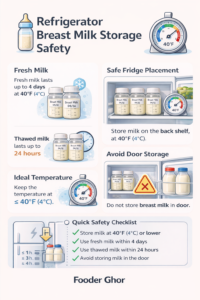
For many new moms, one question comes up very early in their feeding journey. How long can breast milk last in the refrigerator? The short answer is up to 4 days for freshly pumped milk and 24 hours for thawed milk. However, storage safety depends on temperature, placement, and handling habits.
Breast milk contains living nutrients, immune cells, and enzymes. Refrigeration slows bacterial growth but does not stop it completely. Therefore, understanding refrigerator storage rules helps protect milk quality while ensuring your baby receives safe nutrition at every feeding.
Keeping a close eye on your refrigerator temperature is the best way to maintain the integrity of your liquid gold. While life with a newborn is chaotic, having a clear understanding of refrigeration science provides peace of mind. This guide explores the essential rules, best locations for storage, and how to handle different types of milk within your fridge.
Quick Breast Milk Fridge Safety Summary
If you are in a hurry, follow these essential refrigerator and freezer safety rules.
- Freshly Pumped Milk: Safe for up to 4 days at 40°F (4°C)
- Thawed (Previously Frozen) Milk: Safe for 24 hours only
- Best Storage Location: Always at the back of the lowest shelf
- Deep Freezer Storage: Supports longer-term milk preservation
These safety timelines follow recommendations from the Centers for Disease Control and Prevention, where household milk storage guidance is regularly updated for parents. Refrigeration preserves milk safely for several days, but strict timing must be followed.
How Long Breast Milk Last in the Refrigerator – Visual Storage Guide
Freshly Pumped vs Thawed Milk: Refrigerator Storage Time Differences
You must distinguish between freshly expressed milk and milk that has been previously frozen. Freshly pumped milk can stay in the fridge for up to 4 days due to its natural antibacterial properties. However, if you are using milk that was moved from the freezer to the fridge, it must be used within 24 hours once it fully thaws.
The biological makeup of breast milk changes during the freezing process. Freezing breaks down some of the protective cells, which makes thawed milk more susceptible to spoilage. According to the official CDC breast-milk-preparation-and-storage guidelines, you should never treat thawed milk with the same 4-day window as fresh milk. Always mark your storage bags with the date of expiration and the date it was moved to the fridge to avoid confusion.
👉 To gain a broader perspective on how different temperatures affect your supply, you can learn how long breast milk lasts across all storage methods.
How to Thaw Deep Frozen Breast Milk Safely
After long-term freezer storage, proper thawing is essential for maintaining milk safety.
The safest method is to transfer frozen milk from the deep freezer to the refrigerator and allow it to thaw overnight. If you need milk more quickly, place the sealed storage bag or bottle under lukewarm running water.
Never thaw or warm breast milk in a microwave, as uneven heating can destroy nutrients and create dangerous hot spots.
Once breast milk has completely thawed in the refrigerator, it should be used within 24 hours. Previously frozen milk should never be refrozen after thawing, according to the CDC Human Milk Storage Guidelines.
Optimizing Your Fridge: Placement and Temperature Rules
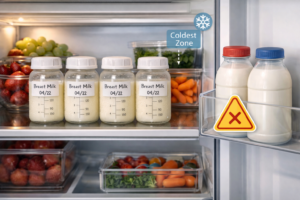
Temperature stability is the primary defense against bacterial growth. Breast milk must be stored at or below 40°F (4°C). According to the Centers for Disease Control and Prevention, maintaining proper refrigeration temperature helps preserve breast milk quality and reduce contamination risk. To ensure this, always place your containers at the back of the lowest shelf, which is the coldest part of the unit.
Avoid the Door: Never store breast milk in the refrigerator door. The constant opening and closing exposes the milk to warm kitchen air, causing temperature spikes that degrade quality. The U.S. Food and Drug Administration also recommends using colder, more stable refrigerator zones for sensitive stored foods.
For accuracy, keep an appliance thermometer inside to monitor refrigerator consistency and ensure your cooling system is functioning correctly.
Can You Freeze Breast Milk After 4 Days in the Refrigerator?
Milk can technically be frozen within the 4-day window. It is safe to freeze breast milk after 4 days in the fridge, but experts recommend doing it sooner. The USDA suggests that for optimal quality, you should move milk to the freezer within the first 24 to 48 hours. While freezing on the fourth day is acceptable, the nutritional value might be slightly lower than milk frozen immediately.
If you know you will not use a specific batch within the 4-day window, move it to the freezer right away. This preserves the maximum amount of vitamins and antibodies for your baby. Once the milk passes the 4-day mark in the fridge, it should not be frozen for future consumption. Instead, discard any milk that has exceeded the recommended time limit. Milk that approaches the end of its refrigerator window should be frozen sooner rather than later for better long-term preservation.
Small takeaway: Earlier freezing generally helps preserve milk quality more effectively.
Long-term preservation recommendations are also supported by the U.S. Food and Drug Administration in household food storage guidance.
Long-Term Storage: Deep Freezer vs. Standard Freezer
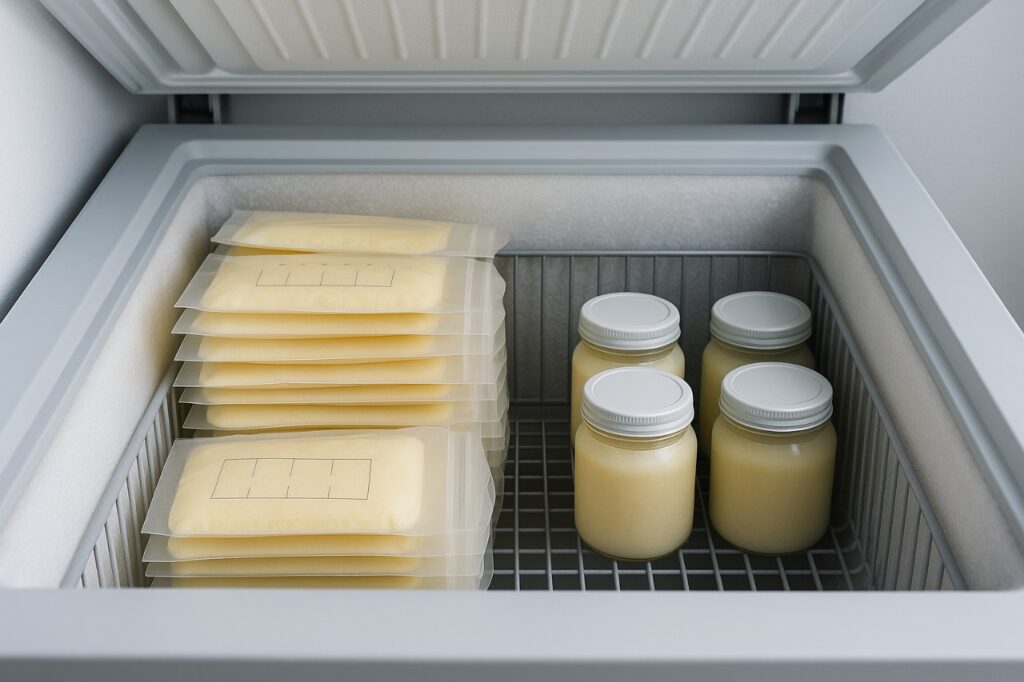
For parents building a long-term milk stash, a dedicated deep freezer is often the most reliable storage option for preserving frozen breast milk over extended periods.
A standard refrigerator freezer is generally used for shorter-term frozen storage because the door opens frequently throughout the day, causing more temperature fluctuation. In contrast, a separate deep freezer stays colder and more temperature-stable, which helps preserve milk quality more effectively over time.
According to the Centers for Disease Control and Prevention (CDC), breast milk stored in a freezer compartment inside a refrigerator is typically best used within several months, while a dedicated deep freezer maintained at 0°F (-18°C) or colder supports longer-term storage and better temperature consistency.
The main benefit of a deep freezer is stability. Since it is opened less often than a kitchen freezer, the milk experiences fewer warm air exposures, helping protect fats, enzymes, and immune-supporting components more consistently.
For best long-term quality, many parents aim to keep deep freezer temperatures consistently between 0°F and -4°F whenever possible. Using a freezer thermometer can help verify temperature reliability and prevent unnoticed fluctuations.
Small takeaway: Deep freezers are generally better for building long-term milk reserves because colder, more stable temperatures help preserve milk quality longer.
Power Outage and Fridge Failure: Is Your Milk Still Safe?
During a power failure, breast milk remains safe for up to 4 hours in a closed refrigerator. To preserve the cold environment, avoid opening the door unless absolutely necessary. If the outage lasts longer, check the milk containers; if they still contain ice crystals or feel refrigerator-cold, they can be saved. However, if the milk has reached room temperature, it should be discarded to ensure infant safety.
The Lipase Factor: Why Refrigerated Milk May Smell Soapy
You might notice a soapy or metallic smell when taking milk out of the fridge. This is often caused by high levels of lipase, an enzyme that helps your baby digest fats. When milk stays in the fridge, this enzyme starts breaking down the milk fats, which can change the aroma and taste.
The milk is still safe for your baby to drink, although some infants might refuse the bottle. If your baby dislikes the soapy taste, you can try scalding the milk before putting it in the fridge. This process deactivates the enzyme and keeps the flavor fresh. It is important to distinguish this soapy smell from the sour odor of spoiled milk. If the milk smells like rancid grease or sour cow milk, it has gone bad and should be thrown away.
Infant feeding guidance regarding milk acceptance can be reviewed through the American Academy of Pediatrics.
Can You Re-Chill Breast Milk After Warming?
Breast milk that has been refrigerated behaves differently once it is heated for feeding.
After milk leaves cold storage and is warmed, safety timelines become shorter and handling becomes more time-sensitive.
Because warming introduces separate storage rules, parents should always follow warming-specific safety guidance after heating refrigerated milk.
For full warming rules, read How Long Does Breast Milk Last After Warming.
How Long Before Refrigerated Breast Milk Goes Bad?
Breast milk stored properly remains safe for up to 4 days.
According to the Centers for Disease Control and Prevention (CDC), freshly expressed breast milk should be used within recommended refrigeration timelines to help reduce spoilage and bacterial growth risk.
You can often identify spoiled milk by changes in smell and consistency. While fresh breast milk naturally separates into layers, spoiled milk may appear unusually clumpy or develop fat strands that do not remix after gentle swirling.
A sour or unpleasant odor is usually the most reliable sign that milk should be discarded. If you are ever uncertain about milk quality, it is safer not to use it.
Maintaining strong hygiene habits while pumping and storing milk can help preserve freshness throughout the refrigeration window. Using sterilized containers, minimizing unnecessary handling, keeping the refrigerator clean, and avoiding cross-contamination with raw foods all contribute to safer milk storage. The U.S. Food and Drug Administration (FDA) also recommends proper refrigerator hygiene to reduce contamination risks in stored foods.
Small takeaway: If smell, texture, or storage timing seems questionable, discarding milk is the safer choice.
👉 You can explore spoilage identification signs inside this milk safety recognition guide, which explains visual and smell changes parents should monitor.
Fridge to Room Temperature: How Long Can Milk Stay Out?
Moving Milk From Refrigerator to Feeding
Once milk is removed from refrigerator storage, feeding preparation should begin promptly.
Important factors include:
- Whether milk stays chilled
- Whether milk is warmed before feeding
- How long milk remains outside cold storage
Cold-chain consistency helps maintain milk quality more effectively.
For complete counter and room temperature rules, read How Long Can Breast Milk Stay at Room Temperature.
Refrigerator Breast Milk Safety Checklist for Busy Moms
- Store milk on the back shelf
- Maintain temperature below 40°F
- Label containers clearly
- Use the oldest milk first
- Avoid door placement
- Freeze before day 4 if needed
Why Trust Fooder Ghor?
At Fooder Ghor, we provide educational resources focused on understanding the safe use, handling, and storage of different types of milk, including breast milk, cow’s milk, goat milk, and raw milk, based on publicly available guidance from trusted sources such as the CDC, FDA, USDA, and AAP. Some milk-related articles, particularly those involving maternal and infant feeding topics, are reviewed for clarity and presentation by nursing students with academic training in maternal and child health to help make information easier to understand. This content is provided for learning purposes only and does not offer medical advice.
Most Common Questions About Refrigerator Breast Milk Storage
A: No. Use within 4 days for safety.
A: No. The refrigerator door experiences more temperature fluctuation.
A: Frequent opening causes temperature fluctuation.
A: No. Freshly pumped breast milk is generally safest within 4 days.
A:It is not recommended.
A: Both are fine as long as they are food-grade and BPA-free. Glass holds cold temperatures very well.
A: Yes, but monitor the temperature closely. Mini fridges are prone to temperature fluctuations.
A: Breast milk stored at 0°F (-18°C) or colder can stay safe for up to 12 months, although using it within 6 months is best for quality.
A: Yes, due to the lipase enzyme, it may smell soapy. This is safe unless it smells sour or rancid.
A: Yes. Glass bottles are commonly used for breast milk refrigeration when properly sealed.
A: Yes, as long as refrigerator temperature stays consistently cold.
Conclusion
Knowing how long breast milk lasts in the refrigerator helps parents build a safe feeding system. Fresh milk stays safe up to 4 days. Thawed milk lasts 24 hours. Previously warmed milk must be used quickly.
Proper temperature control, correct placement, and timely freezing protect nutrients while reducing waste. Following refrigerator storage safety ensures every feeding remains safe, nourishing, and reliable for your baby.
👉 To understand complete breast milk storage timelines across all environments, this comprehensive duration guide explains refrigeration, freezing, and warming safety together.
Expand Your Breast Milk Storage & Safety Knowledge
To build a safe and efficient milk storage system at home, it is essential to understand how environmental factors affect your supply. These specialized resources provide the technical depth needed to manage every stage of your breastfeeding journey with confidence.
The Ultimate Guide to Breast Milk Storage Durations: This is our comprehensive pillar resource that provides a complete overview of safety timelines for room temperature, refrigeration, and freezing in one master guide.
-
Safe Handling Rules for Warmed and Leftover Milk: A deep dive into the critical two-hour safety window and why specific reheating habits are vital for preventing bacterial growth after warming.
-
Essential Guidelines for Room Temperature Exposure: Understand how quickly fresh milk can degrade on the counter and the best practices for keeping bottles safe during immediate feeding sessions.