Skip to content
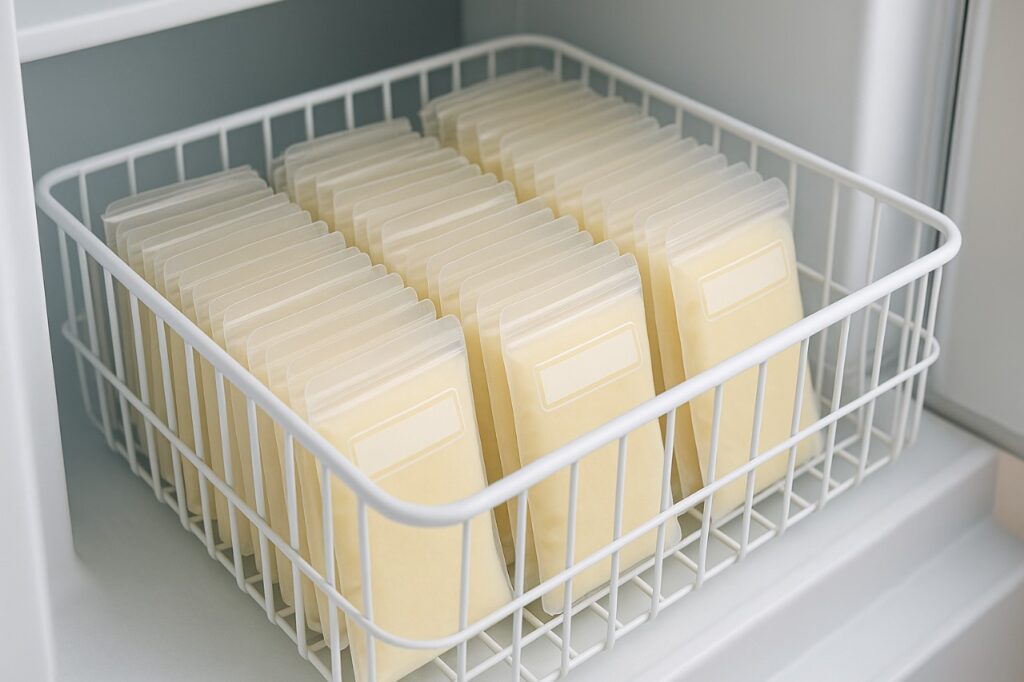
For new moms across the U.S, managing limited freezer space can be tricky, especially when breast milk bags start piling up. The secret to saving space while keeping your milk organized and safe is learning how to freeze breast milk flat properly. This method ensures each bag freezes evenly, stacks neatly, and thaws faster when needed.
Quick Summary: The Essentials of Flat Freezing
If you’re in a hurry, here are the core rules for freezing breast milk flat to save space and ensure safety:
-
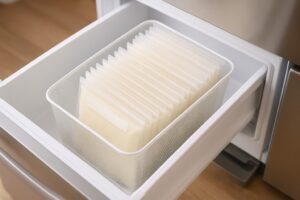
Space Saving: Freezing bags horizontally allows you to stack them like files, saving up to 50% more space。
-
Quality Control: Flat bags freeze more evenly and thaw much faster, which helps preserve vital nutrients。
-
The Golden Rule: Never stack bags until they are frozen solid to prevent uneven shapes or leaks。
-
Safety Window: Use flat-frozen milk within 6-12 months for best quality, and always follow the CDC storage timelines。
-
Handling: Once thawed, never refreeze. If warmed, follow the 2-hour safety rule。
Why Flat Freezing Matters
Freezing breast milk flat isn’t just about space efficiency — it’s about safety and convenience.
- Faster Thawing: Flat, thin bags thaw quicker than bulky frozen pouches, preserving nutrients better.
- Space Efficiency: You can store more milk in the same freezer space, perfect for working moms or exclusive pumpers.
- Better Organization: Labeling and stacking are easier, reducing waste and confusion.
- Even Freezing: Prevents uneven freezing patterns and improves portion consistency during storage.
While the flat freezing method is best for organization, you must also follow the correct timelines for safety. For a full breakdown of how many months milk stays safe in different types of freezers, check our complete breast milk storage duration guide.
Tip: According to the CDC Breast Milk Storage Guidelines, ensure milk is stored in clean, food-grade, BPA-free storage bags before freezing.
Step-by-Step: How to Freeze Breast Milk Flat
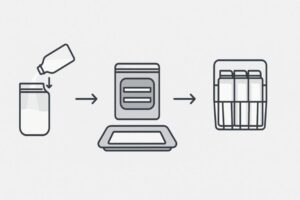
Step 1: Prepare & Label Bags
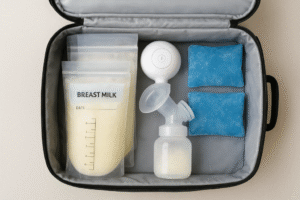
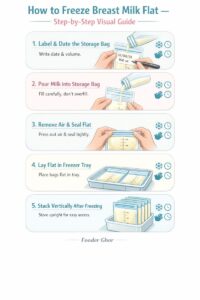
- Use breast milk-specific storage bags — not ordinary plastic bags.
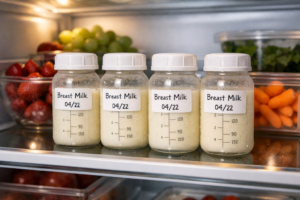
- Label each with the date, time, and volume before filling.
- Leave about 1 inch of space at the top for expansion during freezing.
Step 2: Lay Flat for Initial Freezing
- Lay each bag horizontally on a clean tray, baking sheet, or cutting board.
- Ensure the air is pushed out before sealing.
- Avoid stacking bags until they’re fully solid.
Step 3: Stack & Organize Efficiently
- Once frozen solid, stand or stack the flat bags vertically like files in a box or basket.
- Place newer milk behind older batches to maintain a first-in-first-out rotation.
- Store in the back of the freezer, not on the door — where temperature fluctuates.
How to Freeze Breast Milk Flat: Step-by-Step Visual Guide
Best Practices for Flat Storage
- Use freezer-safe bags only (ordinary zip bags can leak or crack).
- Keep freezer temperature at 0°F (-18°C) or lower.
- Group bags by week or month using rubber bands or small storage bins.
- Use silicone bag organizers or labeled bins for easy identification.
- Avoid overfilling — 5 oz per bag is ideal for flat freezing.
Common Mistakes to Avoid:
❌ Storing bags upright while still liquid — leads to uneven shapes.
❌ Forgetting to label before freezing — causes mix-ups.
❌ Freezing near the door — exposes milk to temperature variation.
❌ Reusing single-use bags — can cause leaks or contamination.
FAQ: Flat Freezing Breast Milk
Q1: Can I freeze breast milk flat in sandwich bags?
No. Only use breast milk storage bags that are BPA-free and pre-sterilized. Sandwich bags may leak or introduce bacteria.
Q2: How long can flat-frozen milk last?
A: According to the CDC, when frozen flat and stored properly at $0^{\circ}\text{F}$ ($-18^{\circ}\text{C}$) or lower, breast milk is best used within 6 months, though it can stay safe for up to 12 months. For a printable chart with exact times for fridge and room temperature storage, see our breast milk storage guide.
Q3: Is it okay to stack bags before they’re frozen solid?
Avoid doing so — stacking before full freezing can cause uneven shapes and leaks.
Q4: Can I refreeze thawed milk if it’s still cold?
A: No. Once milk has completely thawed, it should never be refrozen. It must be used within 24 hours in the fridge. If you choose to warm that milk for a feeding, a different safety window applies. Learn exactly why in our guide on breast milk safety after warming.
Why Trust Fooder Ghor?
At Fooder Ghor, we provide carefully researched content based on trusted U.S. health and food safety authorities such as the CDC, USDA, FDA, and AAP. Our mission is to help U.S. parents and families use milk safely and make confident, informed decisions for their children and households. We simplify complex guidelines into practical, mom-friendly advice and regularly update our content to reflect the latest safety recommendations.
Conclusion: A Smarter, Cleaner Way to Store Breast Milk
Flat freezing is a simple yet effective method that helps U.S. moms stay organized while ensuring their baby’s milk remains safe and nutrient-rich.
By following this guide, you’ll make the most of your freezer space and minimize stress during those late-night feeding sessions.
👉 For a complete overview of storage containers and freezing options, read our Ultimate Guide to Milk Storage Containers.
Explore More Breast Milk Storage & Freezing Guides
To build a complete and safe milk storage system, these related guides expand on storage rules, warming safety, and freezer organization:
-
Complete Breast Milk Storage Duration Chart: Now that you know how to freeze your milk flat, use our master guide to see how long milk remains safely stored across different freezer types.
-
How Long Does Breast Milk Last After Warming? Once you thaw your flat-frozen bags and warm them for a feeding, remember to follow the critical 2-hour safety rule.
-
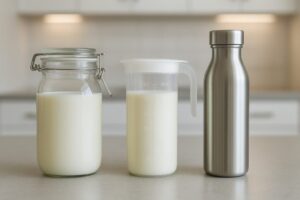
Best Breast Milk Storage Containers: Glass vs Plastic: Choosing the right vessel is key; learn which containers work best for long-term freezing and daily use.
-
Breast Milk Storage in a Deep Freezer: If you are freezing milk flat for the long term, find out how a deep freezer changes the safety timeline.