Skip to content
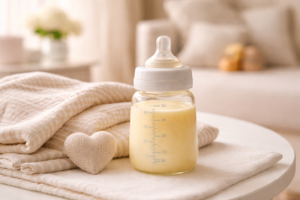
For parents across the U.S., one of the most common questions after pumping is, “How long does pumped breast milk last?” Understanding exactly how long breast milk lasts under different conditions helps you store it safely, keeping your milk nutrient-rich, fresh, and waste-free. This guide breaks down how long bottled breast milk lasts at room temperature, in the fridge, and in the freezer, and provides quick, actionable answers to every major storage question parents face.
What You Will Learn in This Guide
- The official CDC time limits for breast milk at room temperature, fridge, and freezer
- How long thawed or defrosted breast milk remain safe to use
- The critical 2-hour rule for warmed or leftover milk (including reheated milk)
- Essential safety tips to avoid common storage mistakes in your US kitchen
- Quick answers to FAQs about milk safety after birth and in a cooler
Storage Time Guide: The Official CDC Safety Guidelines
According to the CDC breast milk safety guidelines (Centers for Disease Control and Prevention) are as follows:
Room Temperature Storage: How Long Does Breast Milk Last Outside?
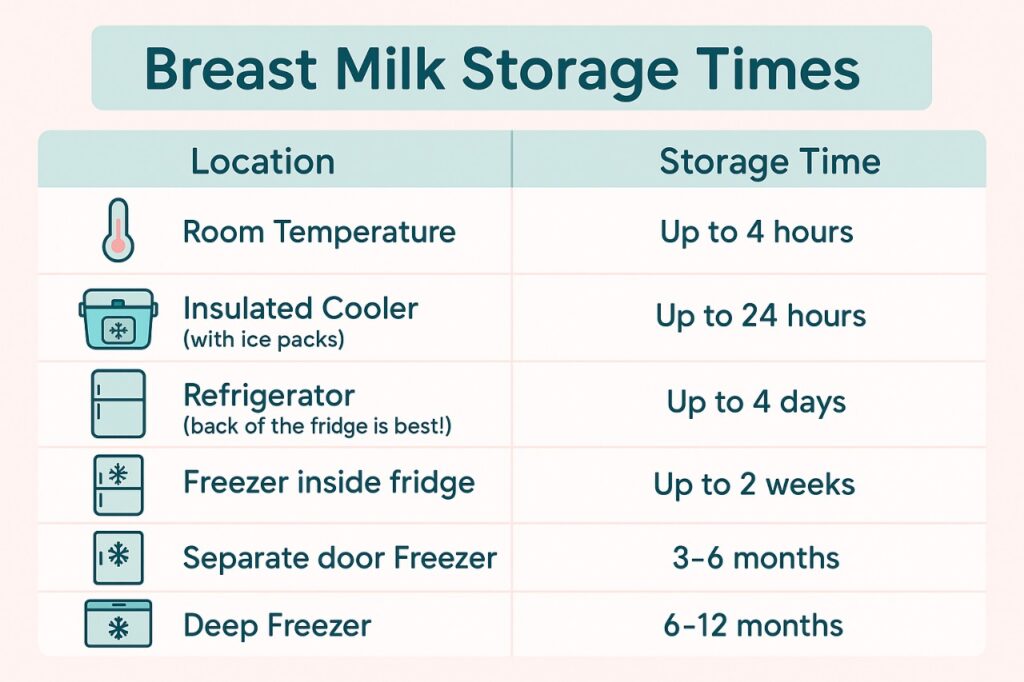
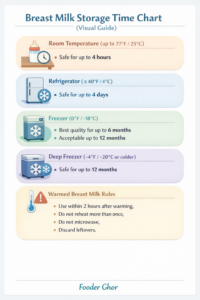
Freshly expressed milk can stay at room temperature ($\le 77^{\circ}\text{F}$ / $25^{\circ}\text{C}$) for up to 4 hours.
- Leftover Milk Rule: Once your baby has drunk from the bottle, discard any leftover breast milk after 2 hours.
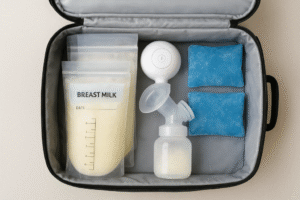
- Travel Tip: If you are traveling or at work, keep milk in an insulated cooler bag with ice packs; it may last up to 24 hours in a well-packed cooler.
Pro Tip: Always chill your milk immediately if you don’t plan to feed within a few hours.
Breast Milk Storage Time Chart (Visual Guide)
Refrigerator Storage: How Long is Breast Milk Good in the Fridge?
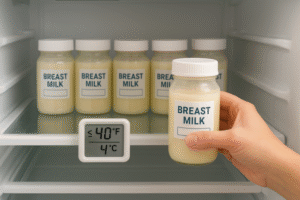
When stored in a refrigerator at or below $40^{\circ}\text{F}$ ($4^{\circ}\text{C}$), bottled breast milk can safely last up to 4 days.
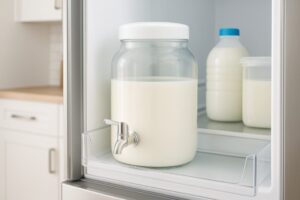
- Placement: Place the milk at the back of the fridge shelf where the temperature remains most stable. Avoid the door compartment.
- Mixing: Avoid adding freshly pumped warm milk to an already chilled bottle cool the new milk completely first.
To maximize the safety window, consider keeping a small appliance thermometer inside your refrigerator to verify the temperature is consistently below $40^{\circ}\text{F}$. Use the ‘First-In, First-Out’ (FIFO) method, ensuring you use the oldest milk batch before the newest ones. Also, remember that milk stored in the fridge should never be refrozen once the four-day limit is approaching. For milk donors or parents storing milk under clinical standards, the Human Milk Banking Association of North America (HMBANA) provides ultra-low temperature guidance.
👉 Deep Freezer Note: While the standard freezer is safe for up to 12 months, for detailed guidance on how long does breast milk last in a deep freezer, see our dedicated article: How Long Does Breast Milk Last in a Deep Freezer?
Freezing & Thawing: Long-Term Storage Essentials
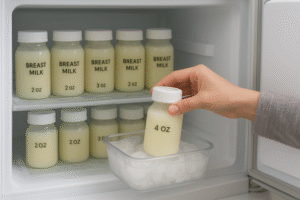
Freezing is the ultimate way to preserve milk for up to 12 months. To maintain quality, the safest method is to thaw milk slowly in the refrigerator overnight.
-
Once Thawed: Use within 24 hours and never refreeze.
-
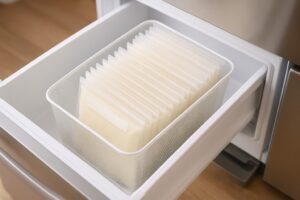
Storage Optimization: How you freeze your milk matters as much as how long you store it. To save 50% more space and ensure even freezing, most U.S. moms prefer freezing milk flat.
Learn the step-by-step process in our specialized guide: How to Freeze Breast Milk Flat for Space Saving.
Warming & Reheating: How Long Does Breast Milk Last Once Heated?
Warming milk changes its biological stability, creating a very specific safety window.
-
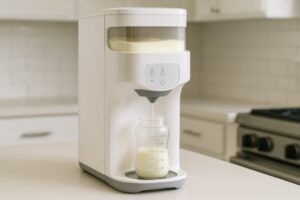
The 2-Hour Rule: Once breast milk is warmed or brought to feeding temperature, it must be used within 2 hours at room temperature.
-
No Reheating: Milk that has already been warmed should never be reheated a second time.
Due to the bacterial risks involved with temperature changes, we have created a dedicated guide on this topic. For a deep dive into the 2-hour rule, re-chilling warmed milk, and specific safety tips, see our full article: How Long Does Breast Milk Last After Warming?
Cleaning, Labeling & Handling Tips
- Hygiene: Always wash hands before expressing or handling milk.
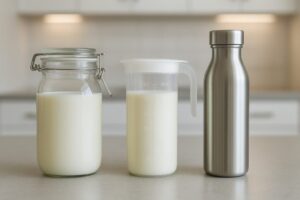
- Containers: Use food-grade glass or BPA-free plastic containers with tight lids.
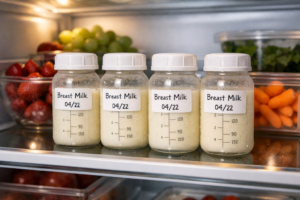
- Labeling: Clearly label each bottled breast milk container with the date and time.
- Mixing: Do not shake milk roughly; instead, swirl gently to mix separated fat.
- Spoilage: Discard milk that smells sour or has a curdled texture.
Ensure your milk is chilled rapidly after pumping; placing containers in an ice bath before transferring them to the fridge is the fastest way to halt bacterial activity. Never ‘top off’ cold milk with warm, freshly expressed milk, this can warm the entire batch and create an unsafe environment. Always freeze milk in small, usable portions (2–4 oz) to minimize feeding waste and ensure efficient thawing when needed.
Most Common Questions
A: Discard any milk leftover in the bottle (after the baby has started drinking) after 2 hours due to bacterial contamination.
A: In a properly packed insulated cooler bag with ice packs, milk can remain safe for up to 24 hours.
A: Colostrum follows the same storage rules as mature breast milk.
A: Breast milk on the counter at room temperature ($\le 77^{\circ}\text{F}$) should be used within 4 hours.
A: Milk that remains in the breast is best used at the next feed; storage times apply once expressed.
A: Once thawed, use it within 24 hours if kept in the fridge. For specific rules on what happens if you warm that thawed milk, refer to our warming safety guide.
A: Only if both are at the same temperature cool the fresh milk first.
A: That’s normal, Fat separation and light reflection change its appearance, not its quality.
A: No. Once the baby starts drinking, bacteria from their mouth enter the bottle. Discard any leftovers after 2 hours. Learn more about managing leftover warmed milk here.
Why Trust Fooder Ghor?
At Fooder Ghor, we provide carefully researched content based on trusted U.S. health and food safety authorities such as the CDC, USDA, FDA, and AAP. Our mission is to help U.S. parents and families use milk safely and make confident, informed decisions for their children and households. We simplify complex guidelines into practical, mom-friendly advice and regularly update our content to reflect the latest safety recommendations.
Conclusion
In summary, proper handling is key:
- 4 hours at room temp → 4 days in fridge → 6 months (best) in freezer
- Always follow hygiene rules and label containers carefully
- Use small batches and avoid reheating milk twice to keep every drop safe and nutritious
Pumping and storing expressed milk is a huge responsibility for every parent. While the process may seem complicated at first, remember that every step you take ensures safe nutrition for your baby. Always remember to chill the milk as quickly as possible. The process of rapid cooling freshly pumped milk (such as placing it in a container of cold water) is highly effective in preventing bacterial growth before refrigeration. It is essential to maintain stable temperatures and seal the containers properly. At the end of the day, what is more important than the rules or guidelines is your confidence and caution. Whenever you have the slightest doubt about the quality of the milk, it is safest to discard it without taking any risks. This habit of safe storage will make your baby’s first years more comfortable and worry-free.
👉 For guidance on best practices for safe milk storage and container comparisons, read: The Best Breast Milk Storage Containers: Glass vs Plastic vs Metal (Ultimate USA Guide).
Expand Your Breast Milk Storage & Safety Knowledge
To build a safe and efficient milk storage system at home, explore our specialized guides:
-
How Long Does Breast Milk Last After Warming? A deep dive into the 2-hour safety rule and how to handle reheated milk.
-
How to Freeze Breast Milk Flat for Space Saving: Master the best technique to organize your freezer and ensure faster thawing.
-
Guide to Breast Milk Storage in a Deep Freezer: Everything you need to know about long-term storage safety for up to 12 months.
-
Choosing the Best Breast Milk Storage Containers: A comparison of glass bottles, BPA-free plastic, and storage bags for U.S. moms.