Skip to content

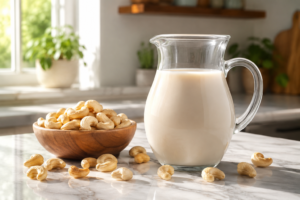
Plant-based dietary alternatives have completely transformed modern American grocery shopping over the last decade. As families seek out smooth, non-dairy fluids to add to their morning routines, understanding the exact energy metrics becomes incredibly essential for daily meal planning. If you are tracking your energy intake, looking closely at cashew milk calories can provide clear insights into what you are consuming every day.
In this comprehensive guide, we will analyze where plant-based energy originates, map out precise calorie numbers across multiple volumetric sizes, execute detailed flavor comparisons, and establish guidelines to determine your ideal consumption levels.
Quick Summary:
- Low Energy Base: Standard unsweetened commercial cashew milk typically provides about 25 calories per cup, making it a light option for everyday use.
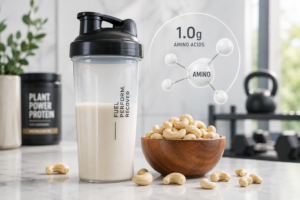
- Natural Energy Source: The calories in cashew milk come primarily from its naturally occurring fats, with smaller contributions from carbohydrates and protein. Learn more in our cashew milk protein guide.
- Flavored Variations: Vanilla and chocolate varieties often contain more calories because they include added sugars and flavoring ingredients.
- Serving Size Matters: Calorie values increase proportionally across 100g, 250g, 500g, and 1 litre, making serving size important when tracking your daily intake.
While calories are an important part of any nutrition plan, they tell only part of the story. If you also want to understand how much plant protein this dairy-free beverage provides and how it compares with other milk alternatives, read our comprehensive guide on cashew milk protein.
Does Cashew Milk Have Calories? Where It Comes From
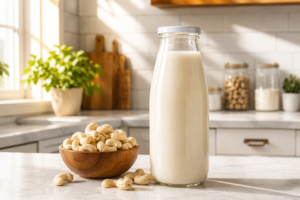
Yes, this plant-based beverage possesses a small, measurable amount of energy that enters the liquid base during the physical blending and extraction of raw nut oils.
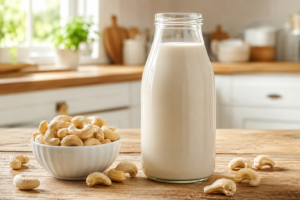
Many families incorporate this drink into their breakfast setups because it is completely lactose-free and remarkably velvety. When exploring the fundamental question, does cashew milk have calories, the mechanical separation of the ingredients plays a major role. To understand exactly where do the calories in cashew milk come from, you have to look at the cellular structure of raw tree nuts. As the nut kernels are crushed and mixed with purified water, small amounts of naturally occurring fats, carbohydrates, and protein from the cashews remain in the finished beverage after blending and processing, contributing to its overall calorie content. The exact amount depends on the recipe, processing method, and whether the product is strained or fortified.
According to USDA FoodData Central, raw cashews naturally contain fats, carbohydrates, and protein that provide energy. Commercial cashew milk retains only a portion of these nutrients after processing, which is why unsweetened varieties are generally low in calories. To understand the wider health advantages of this drink beyond its basic energy structure, check out our guide on cashew milk benefits.
Is Cashew Milk High in Calories? The Relationship Explained
No, this creamy dairy alternative is not considered a high-calorie beverage, as standard unsweetened store cartons contain a minimal 25 calories per kitchen cup.
When tracking modern nutritional goals, defining the relationship between cashew milk and calories requires analyzing how processing lines manage nut concentration. Because the consumer fluid is mostly composed of filtered water to keep the overall texture light, it does not match the heavy energy profiles of denser animal products. To put this energy density into perspective, comparing this light profile with the dense macronutrients of traditional animal farming reveals that it sits at a different level than cow milk nutrition.
Unsweetened Cashew Milk Calories: Volume and Metric Analysis

Standard unsweetened commercial formulations distribute their plant-based energy in a completely linear pattern across common grocery store sizes and metric kitchen weights.
In everyday cooking, having a clear breakdown of unsweetened cashew milk calories per cup, 100g, 250g, 500g, and 1 litre helps keep recipe calculations and meal tracking consistent. While Nutrition Facts labels typically provide values per serving, estimating larger or smaller quantities can be useful for cooking, baking, and meal preparation. The table below uses nutrition data from USDA FoodData Central for a representative unsweetened commercial cashew milk product, with additional serving sizes calculated proportionally for common household and metric measurements.
Unsweetened Cashew Milk Calories Breakdown Table
| Volumetric Measurement | Total Weight (Grams) | Exact Energy Content |
| Standard 100g Metric | 100g | 10.4 kcal |
| Single Kitchen Cup | approx. 240g | 25.0 kcal |
| Standard 250g Serving | 250g | 26.0 kcal |
| Culinary 500g Portion | 500g | 52.0 kcal |
| Bulk 1 Litre Carton | approx. 1000g | 104.0 kcal |
Many fitness enthusiasts track these specific metrics to maintain a steady, predictable intake structure across their daily food plans. For example, using a 250g serving over your morning cereal guarantees you receive a clean 26 calories alongside your healthy fats.
According to USDA FoodData Central, a representative unsweetened fortified cashew milk provides approximately 25 calories per cup. Larger and smaller serving sizes shown in this guide are calculated proportionally from the USDA nutrition data.
Note: Values for 250g, 500g, and 1 litre are calculated from USDA FoodData Central nutrition data for a representative unsweetened commercial cashew milk product. Actual calorie values may vary slightly by brand and formulation. If you want to see how these exact fluid numbers compare to the full fat and carbohydrate charts of the same nut base, read our detailed report on cashew milk nutrition.
How Much Calories in Cashew Milk: Recipe and Brand Scales
Standard plant-based servings deliver varying calorie loads depending directly on whether you are measuring pure commercial fluids, homemade batches, or blended options.
In everyday cooking, answering the question how much calories in cashew milk requires evaluating the processing method used. Commercial unsweetened options are filtered heavily to keep the calorie count at 25 kcal per cup, but preparing a fresh batch in your own kitchen changes the macro scale entirely because it retains more raw nut material. If you trace the volume from 100g up to a full 1 litre, a homemade version can jump from a light drink to a dense kitchen base. To learn how to make a custom, energy-dense mixture in your own kitchen, read our tutorial on how to make cashew milk.
Almond Cashew Milk Calories: Mixed Seed Formulations
Cross-blended commercial beverages bring together two distinct seed groups to form a highly balanced non-dairy option that retains a smooth consistency and a light energy density.
For everyday cooking, choosing a multi-nut carton can add a wider range of nutrients to your morning routine. When analyzing almond cashew milk calories per cup, 100g, 250g, 500g, and 1 litre, the values are generally similar across many unsweetened commercial blends, although the exact calorie content varies by brand and formulation. The table below presents representative values calculated from published Nutrition Facts for unsweetened almond and cashew milk blends.
According to the nutrition information published by Silk and Blue Diamond, unsweetened almond and cashew milk blends are generally low in calories, although the exact values vary depending on the product formulation and serving size.
| Measurement Quantity | Almond Cashew Blend Calories | Recipe Planning Context |
| Per 100g | 12.5 kcal | Micro dietary logging |
| Per Cup | 30.0 kcal | Standard single beverage serving |
| Per 250g | 31.2 kcal | Mid-sized smoothie base |
| Per 500g | 62.5 kcal | Small family soup preparation |
| Per 1 Litre | 125.0 kcal | Weekly meal prep allocation |
This predictable distribution ensures your dietary equations stay intact regardless of your chosen serving size.
Note: Values are calculated from the published Nutrition Facts for representative unsweetened almond and cashew milk blends. Actual calorie values may vary by brand, recipe, and formulation.
If you want to know how individual nut liquids change when they start to break down or go bad over time, look at our informative guide on how long does cashew milk last.
Silk Vanilla & Chocolate Cashew Milk Calories: Flavor Changes

The energy metrics change dramatically when moving from plain options into sweetened commercial dessert profiles due to heavy industrial sugar syrups.
In many homes, utilizing flavored options serves as a special weekend treat. However, looking into silk vanilla & chocolate cashew milk calories: per cup 100g 250g 500g 1 litre shows a massive upward shift compared to plain cartons. A single cup of Silk Vanilla carries around 50 calories, while a single cup of Silk Chocolate spikes to 90 calories because of the added simple sugars.
Commercial Flavored Brand Calories Comparison Table
| Brand Formulation | Calories Per 100g | Calories Per Cup | Calories Per 250g | Calories Per 500g | Calories Per 1 Litre |
| Silk Unsweetened Plain | 10.4 kcal | 25 kcal | 26 kcal | 52 kcal | 104 kcal |
| Silk Unsweetened Vanilla | 12.5 kcal | 30 kcal | 31 kcal | 62 kcal | 125 kcal |
| Silk Sweetened Vanilla | 20.8 kcal | 50 kcal | 52 kcal | 104 kcal | 208 kcal |
| Silk Chocolate Variety | 37.5 kcal | 90 kcal | 93 kcal | 187 kcal | 375 kcal |
As shown in the table, consuming a full 1 litre container of the chocolate variety delivers an intense 375 calories, making it a richer treatment rather than a low-carb daily fluid. For individuals monitoring blood sugar levels or weight metrics, keeping a close eye on these flavored additions is essential to prevent sudden metabolic spikes. For a detailed breakdown of the sweet compounds used in these commercial mixtures, see our overview on cashew milk sugar.
How Much Calories in Cashew Milk is Enough for You?
Determining how many calories from cashew milk are appropriate for you depends on your overall eating pattern, daily energy needs, physical activity level, and personal health goals. Rather than focusing on a single beverage, it is more helpful to consider how cashew milk fits into your total daily calorie intake.
A cup of unsweetened cashew milk typically contains about 25 calories, making it a light option for coffee, smoothies, cereal, and everyday cooking. For people aiming to manage their calorie intake, it can be a suitable alternative to higher-calorie beverages. However, if you have increased energy needs because of regular physical activity or athletic training, your calorie intake should come from a balanced combination of nutrient-dense foods rather than relying on a single beverage. The FDA recommends using the Nutrition Facts label together with your overall eating pattern to make informed food choices, rather than evaluating a single food or beverage in isolation.
If you prefer homemade cashew milk, remember that using more cashews and less water can increase the calorie content per serving. Always review the Nutrition Facts label on commercial products or calculate your homemade recipe if you are closely tracking your daily calorie intake.
For a plant-based option that naturally carries an entirely different, protein-dense legume structure, you can explore our overview on soy milk nutrition.
Why Trust Fooder Ghor?
At Fooder Ghor, we provide educational resources focused on understanding the safe use, handling, and storage of different types of milk, including breast milk, cow’s milk, goat milk, and raw milk, based on publicly available guidance from trusted sources such as the CDC, FDA, USDA, and AAP. Some milk-related articles, particularly those involving maternal and infant feeding topics, are reviewed for clarity and presentation by nursing students with academic training in maternal and child health to help make information easier to understand. This content is provided for learning purposes only and does not offer medical advice.
Most Common Frequently Asked Questions
No, standard kitchen boiling temperatures can alter the physical shape of molecules, but it does not reduce or increase the total weight of the calories inside the fluid.
Commercial brands use heavy industrial water-filtering processes that dilute the nut concentration, whereas homemade versions retain the full, dense nut pulp.
A full liter of unsweetened commercial milk contains only 104 calories, making it highly safe for low-calorie regimes, though a balanced diet is always recommended.
Yes, adding a tablespoon of pure unsweetened cocoa powder adds around 12 to 15 calories, along with a rich chocolate flavor without excess sugars.
Conclusion
In simple terms, cashew milk calories offer a light, user-friendly foundation that fits smoothly into modern dairy-free lifestyles. While plain unsweetened versions remain the absolute best choice for keeping your energy counts close to 25 calories per cup, flavored options like vanilla and chocolate raise the energy metrics significantly. Whether you select standardized commercial options from premium brands or blend a richer mixture at home, knowing these exact numbers ensures your personal wellness tracking stays entirely accurate.
However, if you ever notice a physical discomfort after consuming your morning beverages, it is highly recommended to look into the adverse reactions or potential allergen risks outlined in our complete manual on cashew milk side effects.