Skip to content

Plant-based dietary alternatives have completely transformed modern American grocery shopping over the last decade. As families seek out smooth, non-dairy fluids to add to their morning routines, understanding the exact skeletal support metrics becomes incredibly essential for daily meal planning. If you are tracking your daily mineral intake, looking closely at cashew milk calcium can provide clear insights into how this beverage supports your skeletal structure.
In this comprehensive guide, we will analyze where plant-based minerals originate, map out precise calcium numbers across multiple volumetric sizes, execute detailed flavor comparisons, and establish guidelines to determine your ideal consumption levels.
Quick Summary: Cashew Milk Calcium at a Glance
Fortified Density: Standard commercial unsweetened options are heavily enriched to provide an impressive 450mg of calcium per cup.
Mineral Origins: Natural raw nut fluids contain very minimal calcium, meaning nearly all commercial calcium is added through industrial fortification.
Flavor Stability: Choosing vanilla or chocolate formulations maintains the same fortified mineral levels despite the addition of sugar syrups.
Measurement Scaling: Fortified calcium numbers scale predictably across 100g, 250g, 500g, and bulk 1 litre kitchen volumes.
While calcium supports strong bones and teeth, it works alongside other important nutrients. To see how much plant protein a typical serving provides and how it complements your overall nutrition, read our complete guide on cashew milk protein.
Does Cashew Milk Have Calcium? Where It Comes From
Yes, this plant-based beverage contains a significant amount of calcium, though the vast majority of this mineral is added manually during commercial manufacturing rather than coming from the nut itself.
Many families incorporate this drink into their breakfast setups because it is completely lactose-free and remarkably velvety. When exploring the fundamental question, does cashew milk have calcium, it is vital to separate commercial factory lines from raw home recipes. To understand exactly where do the calcium in cashew milk come from, we must look at the industrial formulation process. While raw nuts contain only a tiny trace of natural minerals, commercial brands mix in high-quality calcium carbonate or tricalcium phosphate during processing, ensuring the final liquid flows with an enriched mineral profile. To understand the wider health advantages of this drink beyond its basic mineral structure, check out our guide on cashew milk benefits.
Is Cashew Milk High or Low in Calcium? The Relationship Explained
Commercial varieties are exceptionally high in calcium due to industrial fortification, whereas pure unfortified homemade versions are naturally much lower in this essential mineral.
When tracking modern nutritional goals, defining the relationship between cashew milk and calcium requires evaluating whether the product has been fortified. A standard fortified commercial cup may provide approximately 450mg of calcium, while an unfortified homemade version contains only the naturally occurring calcium found in cashews, which is considerably lower. According to the U.S. Food and Drug Administration (FDA), the Nutrition Facts label identifies the amount of calcium per serving and the Percent Daily Value (%DV), making it easier to compare fortified and unfortified products when shopping.
To put this mineral density into perspective, comparing this fortified profile with traditional animal farming reveals that a commercial cup actually delivers more calcium than cow milk nutrition.
Is Cashew Milk Calcium Natural? Fortification vs. Raw Nuts
No, the high calcium content found in store-bought cartons is not natural, as raw nuts supply merely a tiny baseline fraction of the total mineral profile found in commercial products.
In everyday cooking, understanding the question is cashew milk calcium natural is central to managing your family’s skeletal wellness goals. While whole cashews contain excellent trace elements like magnesium, they possess a very poor native calcium structure. This means when you enjoy a highly enriched store option, your body is processing added clean mineral complexes designed to mirror traditional dairy properties. If you want to see how this added mineral profile relates to the general fat and carbohydrate charts of the same nut base, read our detailed report on cashew milk nutrition.
How Much Calcium in Unsweetened Cashew Milk: Metric Analysis

Standard unsweetened commercial formulations distribute their fortified plant-based minerals in a completely linear pattern across common grocery store sizes and metric kitchen weights.
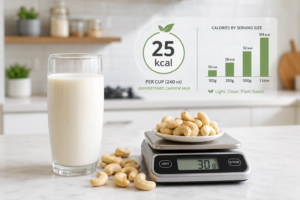
In everyday cooking, having a highly precise breakdown of how much calcium in unsweetened cashew milk: per cup 100g 250g 500g 1 litre allows you to keep your recipe logs completely accurate. Depending on the recipe, a single small splash changes your mineral math minimally, but executing wholesale baking requires calculating the total values present in full bulk liters.
According to USDA FoodData Central, calcium values in fortified cashew milk are reported per serving on Nutrition Facts data, and larger measurements such as 250 g, 500 g, and 1 litre can be calculated proportionally from those published values.
Unsweetened Commercial Cashew Milk Calcium Table
| Volumetric Measurement | Total Weight (Grams) | Fortified Calcium Content |
| Standard 100g Metric | 100g | 187.5 mg |
| Single Kitchen Cup | approx. 240g | 450.0 mg |
| Standard 250g Serving | 250g | 468.7 mg |
| Culinary 500g Portion | 500g | 937.5 mg |
| Bulk 1 Litre Carton | approx. 1000g | 1875.0 mg |
Many fitness enthusiasts track these specific metrics to maintain a steady, predictable intake structure across their daily food plans. For example, using a 250g serving over your morning cereal guarantees you receive a clean 468.7mg of fortified calcium alongside your healthy plant lipids. If you choose to prepare a raw version at home instead, homemade, unfortified cashew milk generally contains much less calcium than fortified commercial products because it relies only on the naturally occurring calcium found in cashews. The exact amount varies depending on the recipe, the cashew-to-water ratio, and whether the milk is strained. To learn how to make a pure, unfortified mixture in your own kitchen, read our tutorial on how to make cashew milk.
How Much Calcium in Silk Vanilla & Chocolate Cashew Milk

Flavored commercial formulations maintain the exact same high levels of fortified calcium as plain varieties, ensuring your mineral intake remains completely stable across different tastes.
In many homes, using flavored options serves as a wonderful alternative to traditional desserts. When evaluating how much calcium in silk vanilla & chocolate cashew milk: per cup 100g 250g 500g 1 litre, the brand protocols ensure that the added mineral blend stays completely identical whether you prefer unsweetened, vanilla, or rich chocolate profiles.
Silk Flavored Cashew Milk Calcium Content Table
| Serving Volume | Silk Unsweetened Plain | Silk Unsweetened Vanilla | Silk Sweetened Vanilla | Silk Chocolate Variety |
| Per 100g | 187.5 mg | 187.5 mg | 187.5 mg | 187.5 mg |
| Per Cup | 450.0 mg | 450.0 mg | 450.0 mg | 450.0 mg |
| Per 250g | 468.7 mg | 468.7 mg | 468.7 mg | 468.7 mg |
| Per 500g | 937.5 mg | 937.5 mg | 937.5 mg | 937.5 mg |
| Per 1 Litre | 1875.0 mg | 1875.0 mg | 1875.0 mg | 1875.0 mg |
As shown in the table, a full 1 litre container of any Silk variety supplies an intense 1875mg of calcium. However, it is essential to remember that flavored versions carry significantly higher amounts of carbohydrates and simple sugars. For individuals monitoring blood glucose levels or daily sugar boundaries, tracking these flavor additions is necessary to keep your metabolic health completely balanced. For a detailed breakdown of the sweet compounds used in these mixtures, see our overview on cashew milk sugar.
How Much Calcium in Cashew Milk is Enough for You?
Determining your ideal intake depends on your specific age bracket, skeletal wellness objectives, and how much calcium you absorb from the rest of your daily meals.
When calculating how much calcium in cashew milk is enough for you, it is essential to align your fluid intake with standard medical recommendations. For a standard adult, a single cup of fortified milk supplies nearly thirty to forty percent of your daily mineral requirements. Enjoying two cups throughout the day provides an excellent mineral foundation, ensuring you meet your structural quotas without needing extra pills.
According to the National Institutes of Health (NIH) Office of Dietary Supplements, most adults aged 19 to 50 need 1,000 mg of calcium per day, while women over age 50 and men over age 70 generally require 1,200 mg daily. A cup of fortified unsweetened cashew milk providing about 450 mg of calcium can contribute substantially toward meeting these daily calcium recommendations.
To learn how these retail containers behave when stored over extended periods in your refrigerator, see our comprehensive guide on how long does cashew milk last.
Why Trust Fooder Ghor?
At Fooder Ghor, we provide educational resources focused on understanding the safe use, handling, and storage of different types of milk, including breast milk, cow’s milk, goat milk, and raw milk, based on publicly available guidance from trusted sources such as the CDC, FDA, USDA, and AAP. Some milk-related articles, particularly those involving maternal and infant feeding topics, are reviewed for clarity and presentation by nursing students with academic training in maternal and child health to help make information easier to understand. This content is provided for learning purposes only and does not offer medical advice.
Most Common Frequently Asked Questions
Yes, added minerals naturally separate and settle over time, which is why you must always shake the carton thoroughly before pouring to ensure an equal serving.
Studies show that calcium carbonate and tricalcium phosphate used in plant milks offer a highly comparable absorption rate to the natural calcium found in animal dairy.
No, calcium is a highly stable mineral element, meaning standard kitchen boiling or heating will not reduce or destroy the calcium value inside the fluid.
Unfortified homemade versions do not provide enough calcium for growing children, so kitch-prep varieties should not replace high-calcium options in their diets.
Conclusion
In simple terms, cashew milk calcium provides an exceptionally rich, user-friendly foundation that fits smoothly into modern dairy-free lifestyles. While raw unfortified homemade versions are naturally very low in minerals, standard commercial options are heavily fortified to deliver a powerful 450mg of calcium per cup across all flavor profiles, including vanilla and chocolate. Whether you select standardized commercial options to support your daily skeletal goals or blend a light unfortified mixture at home, knowing these exact numbers ensures your personal wellness tracking stays entirely accurate.
However, if you ever notice a physical discomfort after consuming your morning beverages, it is highly recommended to look into the adverse reactions or potential allergen risks outlined in our complete manual on cashew milk side effects.