Skip to content
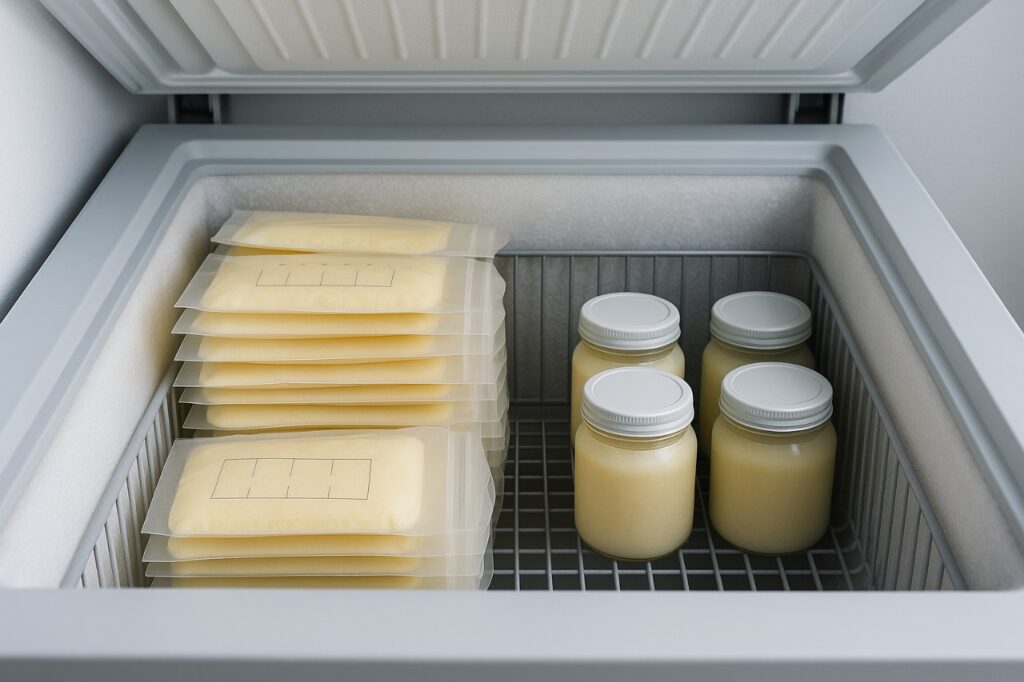
For many U.S. parents, especially working mothers and donors, understanding how long is breast milk good in the deep freezer is key to keeping milk safe and nutritious during long-term storage for their babies.
According to the Centers for Disease Control and Prevention (CDC), milk kept at $0^{\circ}\text{F}$ ($-18^{\circ}\text{C}$) or colder can stay safe up to 12 months, though it is best used within 6 months for optimal nutrition. When stored under clinical standards, the Human Milk Banking Association of North America (HMBANA) often maintains donor milk at $-40^{\circ}\text{C}$ ($-40^{\circ}\text{F}$) or below. This ultra-low-temperature standard highlights why temperature control is critical for nutrient retention and safety.
This guide provides U.S. parents with everything they need to know about deep freezer storage, covering optimal settings, space management, and nutrient preservation.
What You Will Learn in This Guide
- Why a deep freezer is fundamentally better than a standard freezer for long-term breast milk safety.
- The exact temperature setting ($^{\circ}\text{F}$ and $^{\circ}\text{C}$) your deep freezer should maintain.
- The essential HMBANA guidelines for extended preservation.
- Practical tips on selecting the right size and organizing your deep freezer stash.
- The safest method for thawing milk after prolonged deep freezer storage.
Why a Deep Freezer is Better for Breast Milk Safety?
You might ask, “Is a deep freezer better for breast milk?” The short answer is yes. A deep freezer is crucial for parents planning to store a significant milk stash for several months.
- Superior Nutrient Retention: Standard refrigerator freezers experience frequent temperature fluctuations when the door is opened. These cycles degrade sensitive nutrients and immune properties in the milk. A dedicated deep freezer ensures a more stable, consistently cold environment.
- Safety Over Time: Why is a deep freezer important? Because it minimizes the risk of oxidation and bacterial growth over the 6-12 month period. The ability to maintain temperatures below $0^{\circ}\text{F}$ ($-18^{\circ}\text{C}$) provides a crucial buffer against microbial activity.
- Clinical Comparison: The Human Milk Banking Association of North America (HMBANA) maintains donor milk at ultra-low temperatures to ensure long-term microbiological stability. While home freezers cannot reach those ultra-low temperatures, using a dedicated unit is the best step toward maximizing quality at home.
Optimal Deep Freezer Temperature & Settings for Milk
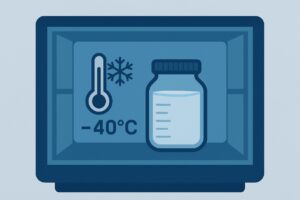
To ensure you get the maximum safe storage time, you must maintain the correct temperature.
What setting should a deep freezer be on for breast milk?
- Standard Freezer Target: At a minimum, your freezer must maintain $0^{\circ}\text{F}$ ($-18^{\circ}\text{C}$) or colder.
- Deep Freezer Target: For long-term peace of mind, aim for $0^{\circ}\text{F}$ to $-4^{\circ}\text{F}$ ($-18^{\circ}\text{C}$ to $-20^{\circ}\text{C}$).
- Verification is Key: Deep freezer temp for breast milk should be verified with a small appliance thermometer placed inside the unit. Relying on the dial setting alone is risky.
Pro Tip: Avoid setting the temperature too cold unless you are using a chest freezer designed for ultra-low temperatures. Ensure the temperature remains constant; fluctuations are the enemy of longevity.
👉 For a complete overview of milk storage, including fridge and room temperature guidelines, see our main guide How Long Does Breast Milk Last?
Deep Freezer Storage: Size, Space, and Organization
Proper organization is essential to fully utilize the long storage life.
- Size Guide (Cubic Feet):
- Small Stash: $3.5$ to $5$ cubic feet is enough for short-term overflow or a few months’ supply.
- Long-Term/Donor Stash: $7$ to $10$ cubic feet is ideal for those storing many months’ worth or planning to donate.
- Type Matters: Chest freezers typically maintain a more stable temperature than upright freezers (as the cold air doesn’t fall out when you open the door).
- Organization:
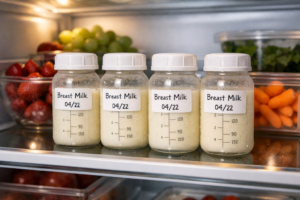
- Labeling: Always label milk with the original expression date and volume.
- Rotation (FIFO): Place newer milk behind older batches, ensuring you use the oldest milk first (“first in, first out”).
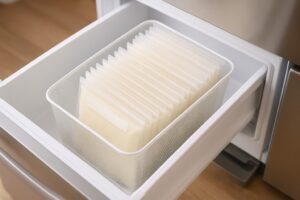
- Flat Freezing: Freeze milk bags flat initially, then stack them vertically in dedicated bins or wire racks.
Thawing from the Deep Freezer
The thawing process is critical to maintaining the milk’s safety and quality.
- Safest Method: Thaw milk in the refrigerator overnight.
- Quick Thaw: Place the sealed bag/bottle under lukewarm running water (do not use hot water).
- Never Microwave: Never microwave frozen milk—it destroys nutrients and creates hot spots.
- Once Thawed: Once fully thawed, use the milk within 24 hours and never refreeze it.
👉 If you’re planning to organize your freezer stash efficiently, check out our step-by-step guide How to Organize Breast Milk in Freezer?
Most Common Questions About Breast Milk Storage on Deep Freezer
Q: Can I put breast milk straight from the pump into the deep freezer?
A: Yes, you can. Freezing immediately preserves maximum nutrients, provided the milk is quickly chilled first (e.g., in the fridge for 30 minutes) or frozen in small portions.
Q: How long is breast milk good in the deep freezer?
A: Milk kept at $0^{\circ}\text{F}$ ($-18^{\circ}\text{C}$) or colder remains safe up to 12 months, though it’s best used within 6 months for optimal nutrition.
Q: Does breast milk lose nutrients after 6 months in the deep freezer?
A: While milk remains safe for up to 12 months, antioxidant levels and fat content may gradually decrease after 6 months. Using milk within 6 months preserves most nutrients.
Q: Is a deep freezer better than a standard freezer for breast milk?
A: Yes. A deep freezer maintains a stable, consistently cold temperature, minimizing nutrient loss, oxidation, and bacterial growth over long-term storage.
Q: What setting should a deep freezer be on for breast milk?
A: Aim for $0^{\circ}\text{F}$ to $-4^{\circ}\text{F}$ ($-18^{\circ}\text{C}$ to $-20^{\circ}\text{C}$). Use an appliance thermometer to verify, as dial settings alone may fluctuate.
Q: Can I mix milk pumped on different days if both are frozen?
A: Yes, as long as both batches were frozen within their safe time frame (after 4 days in the fridge) and stored in small portions.
Q: How can I safely transfer frozen breast milk to another location?
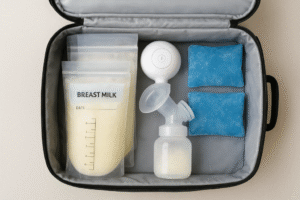
A: For long trips, use a high-quality insulated cooler packed with dry ice. For shorter trips under 24 hours, frozen gel packs in a full cooler work well.
Q: How long can thawed milk from the deep freezer be kept?
A: Once fully thawed in the refrigerator, use milk within 24 hours and never refreeze it.
Conclusion
Deep freezer storage offers the longest safe window for breast milk up to 12 months under home conditions and even longer under HMBANA’s ultra-low clinical standards ($-40^{\circ}\text{C}$).
Why is a deep freezer important? It provides the temperature stability necessary to retain vital nutrients and protect against bacterial risks over time. Maintain a steady temperature below $0^{\circ}\text{F}$, use quality containers, and rotate your supply to keep nutrients and flavor intact. How long breast milk lasts in a deep freezer ultimately depends on your consistent temperature control, clean handling, and the right storage containers.
👉 If you need more verified information, you may visit the Centers for Disease Control and Prevention (CDC).