Skip to content
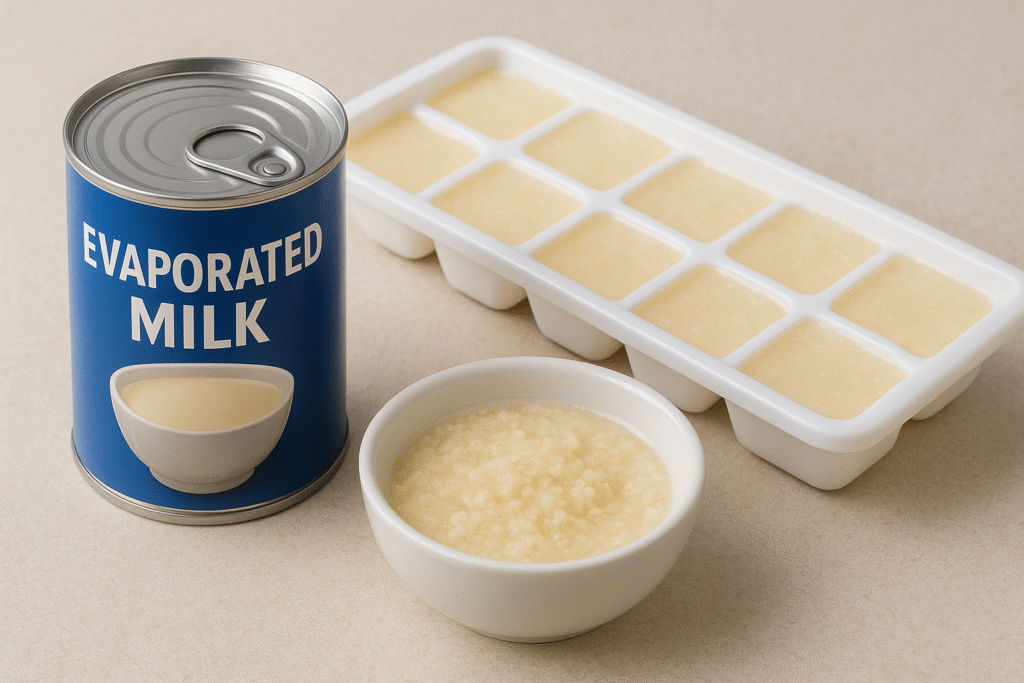
If you frequently use evaporated milk for creamy casseroles, sauces, or holiday baking, you might often find yourself with half a can leftover. The question often comes up: Can you freeze evaporated milk safely?
The immediate answer is: Yes, freezing evaporated milk is completely safe from a food safety perspective, but the quality and texture will change drastically. Unlike regular milk, evaporated milk lacks water and contains concentrated milk solids, which separate severely when frozen. This guide will walk U.S. parents through the proper freezing process, how to manage the grainy texture upon thawing, and essential fixes for cooking and baking.
Quick Summary: Freezing Evaporated Milk Safely
Before you put that leftover can in the freezer, here are the most important facts to know:
-
Is it Safe? Yes, freezing is 100% safe for food safety, but the texture will separate and become grainy.
-
Best Practice: Never freeze in the original metal can; always transfer to an airtight, freezer-safe container.
-
Storage Limit: For the best quality and flavor, use your frozen evaporated milk within 4 to 6 months.
-
The Fix: To restore the grainy texture after thawing, use a blender or vigorous whisking to re-emulsify the milk solids.
-
Thawing Rule: Always thaw slowly in the refrigerator overnight to prevent bacterial growth.
Freezing Evaporated Milk: Safety & Storage Visual Guide

The Basics of Freezing Evaporated Milk
Is It Safe to Freeze Evaporated Milk? (The Food Safety Answer)
Freezing evaporated milk is safe and helps prevent food waste in your family’s kitchen. For accuracy, you can also review official storage guidance from the USDA Food Safety and Inspection Service, which explains safe handling practices for dairy products. The change you see is purely a quality issue, not a safety concern.
Step-by-Step Freezing Guide
- Preparation: Never freeze evaporated milk in the original can. The expanding liquid can cause the can to burst, which is messy and unsafe.
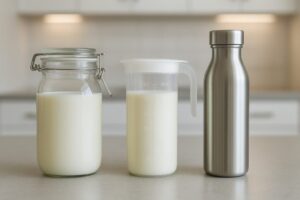
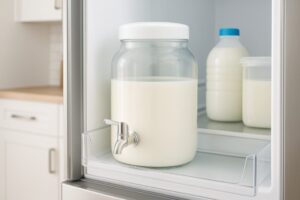
- Portioning: Transfer the leftover milk to small, airtight, freezer-safe containers. Ice cube trays are great for small portions needed for coffee or sauces. If you are unsure which vessel to use, see our comparison of the best milk storage containers to prevent leaks or freezer burn.”
- Labeling: Always label your container with the date. Frozen evaporated milk is best used within 4 to 6 months for optimal quality.
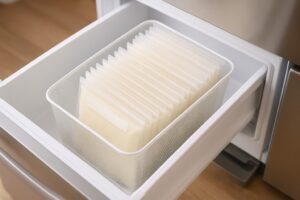
If you are low on space, you can also use the breast milk flat freezing method as a reference for stacking your evaporated milk bags efficiently.
Why Evaporated Milk Freezes Differently (The Science)
Evaporated milk is essentially milk with about 60% of its water content removed.
- The Problem: Because it lacks the stabilizing sugar content of sweetened condensed milk, freezing causes the concentrated milk solids (fats and proteins) and the remaining water to separate severely.
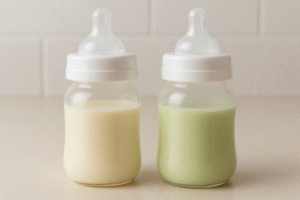
- Result: Upon thawing, you will notice a watery liquid with chunky, grainy, or curdled solids. This is entirely normal.
Thawing and Texture Restoration
How to Thaw Evaporated Milk Without Making It Grainy
- Method: Always thaw slowly in the refrigerator overnight. Never thaw at room temperature, as this encourages bacterial growth.
👉 For additional safe thawing practices, parents can look at the FDA Food Safety Education Resources, which explain why slow refrigeration thawing is the safest method.
Essential Fixes: Restoring the Frozen Texture

If your evaporated milk looks separated after thawing, don’t worry—you can usually fix it or mask the issue for cooking:
- Technique 1 (Whipping/Blending): For best results, pour the thawed milk into a blender or use a hand whisk/mixer. Vigorous whipping can often re-emulsify (re-mix) the separated solids and water, resulting in a smoother, though slightly less uniform, texture. According to the University of Missouri Extension, while freezing may cause some separation of milk solids, it does not impair the safety of the product; whisking or heating after thawing is a recommended method to restore its consistency for cooking and baking.”
- Technique 2 (Heat): The easiest fix is heat. When you add the thawed milk to a warm dish (like a soup, gravy, or casserole), the milk solids usually dissolve fully into the liquid, making it perfectly suitable for savory cooking and baking.
Usage and Comparison
Best Uses for Thawed Evaporated Milk

Because the texture is often compromised, thawed evaporated milk works best in recipes where its texture can be easily blended or dissolved:
- Savory Dishes: Casseroles, mashed potatoes, creamy soups, gravies, and sauces.
- Baking: You can use thawed milk in recipes like breads, muffins, or even a chocolate brownie with condensed milk, where a perfectly smooth liquid texture isn’t critical for the final result.”
- Avoid: Delicate sauces, coffee, or recipes where a smooth finish is mandatory.
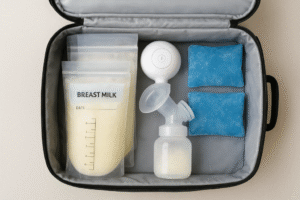
👉 Parents who store milk often may also find our guide on how long breast milk lasts in the freezer helpful for managing family meal prep.
Evaporated Milk vs. Sweetened Condensed Milk: Freezing Differences
The main difference between freezing these two is sugar. Sweetened condensed milk freezes smoothly due to its high sugar content, whereas evaporated milk becomes grainy.
👉 For a full comparison of their shelf life in the pantry and fridge, see our master article on how long evaporated milk lasts versus condensed milk.
Common Frequently Asked Questions About Freeze Evaporated Milk
A: Never. Always transfer the contents into an airtight, freezer-safe container.
A: Up to 6 months for best quality, though it remains safe indefinitely.
A: No, the graininess is a quality issue (cosmetic), not a food safety hazard.
A: Vigorous whisking or blending is usually enough. You do not need to boil it.
Why Trust Fooder Ghor?
At Fooder Ghor, we provide carefully researched content based on trusted U.S. health and food safety authorities such as the CDC, USDA, FDA, and AAP. Our mission is to help U.S. parents and families use milk safely and make confident, informed decisions for their children and households. We simplify complex guidelines into practical, mom-friendly advice and regularly update our content to reflect the latest safety recommendations.
Conclusion
Can you freeze evaporated milk? Absolutely. While it’s safe and helps parents reduce kitchen waste, managing the texture is key. By using small portions, thawing in the refrigerator, and quickly whisking or blending the thawed milk, you can easily save your leftovers and ensure they work perfectly in your next family casserole or savory recipe.
Smart Storage Solutions for Every Kitchen
Don’t let your leftover milk go to waste. Check out these related storage and usage guides:
-
How Long Can Evaporated Milk Last? (Official Guide): Now that you know how to freeze it, learn exactly how long it stays fresh in the pantry and fridge.
-
The Ultimate Guide to Making & Using Condensed Milk: Discover how to use your thawed milk in various homemade recipes and the best storage methods.
-
Can You Freeze Sweetened Condensed Milk? Learn why sweetened milk freezes differently and how to handle its unique texture.
-
Chocolate Brownie with Condensed Milk Recipe: A perfect way to use up your stored milk in a delicious, family-friendly dessert.