Skip to content
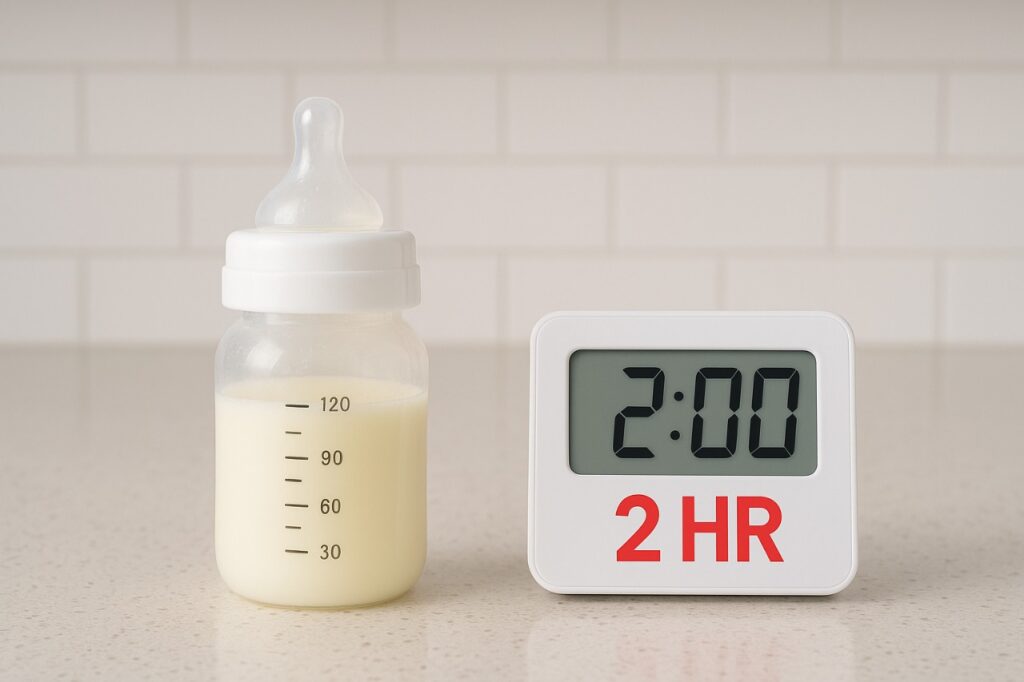
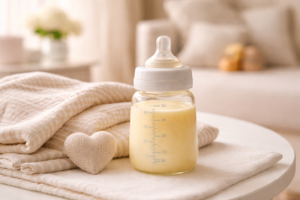
For parents across the U.S., safely feeding a baby requires meticulous timing, especially when dealing with expressed breast milk. Once that nutrient-rich milk leaves the refrigerator or freezer and is brought up to feeding temperature, a safety clock starts ticking rapidly. The most common question and one of the most critical is: How long can heated breast milk sit out before it must be discarded?
Understanding the precise time limits set by health authorities ensures every feeding is safe, minimizes the risk of bacterial growth, and helps you avoid wasting precious milk. This comprehensive guide breaks down the official guidelines for warmed milk, covers specific scenarios like thawed milk, and offers practical tips for parents on the go.
Quick Guide to Heated Breast Milk Safety Rules
- Freshly Warmed Milk: Use within 4 hours at room temperature (if no mouth contact).
- Leftover Milk (Mouth Contact): Must be discarded after 2 hours of feeding.
- Thawed & Heated Milk: Use within a strict 2-hour window at room temperature.
- Reheating: Never heat breast milk more than once.
- Ideal Temp: Warm milk gently to $\mathbf{98^{\circ}\mathbf{F}}$ to $\mathbf{104^{\circ}\mathbf{F}}$.
🌡️ The CDC Safety Clock: Warmed Breast Milk Time Limits
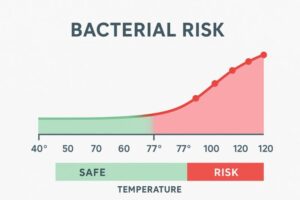
When breast milk is heated, its temperature moves into the “danger zone” where any existing bacteria can multiply quickly. The Centers for Disease Control and Prevention (CDC) provides clear guidelines on how long warmed milk remains safe.
Critical Window: The 4-Hour / 2-Hour Rule Explained
The safety window for milk sitting out depends on the condition of the milk and whether it has touched the baby’s mouth:
- Freshly Warmed Milk (No Mouth Contact): If the milk was recently heated from the refrigerator or freezer, it should be used within 4 hours at room temperature ($\le 77^{\circ}\text{F}$ / $25^{\circ}\text{C}$). The warm temperature accelerates the natural breakdown of protective components, making the 4-hour limit crucial for safety.
- Leftover Milk (After Feeding Starts): Once your baby has begun drinking from the bottle, the risk of contamination from the baby’s mouth (bacteria/saliva) increases dramatically. Any milk leftover in the bottle should be discarded after 2 hours

The crucial thing to remember is that the safety clock begins as soon as the milk is removed from cold storage and warming starts. This includes the time spent warming the milk.
👉 For a complete background on breast milk handling, you may also check the official CDC storage page, CDC Breast Milk Storage Guidelines.
⚠️ Handling Specific Situations After Heating Breast Milk
Different starting conditions require different handling rules. Understanding these differences is key to maximizing safety and minimizing waste, especially with long-term stored milk.
Thawed and Heated Breast Milk Safety
Thawed milk that is subsequently heated requires the most caution. The thawing process itself can slightly increase microbial risk, meaning the safety clock is already advanced.
- How long can thawed heated breast milk sit out? Once frozen milk is thawed and then brought to feeding temperature, it must be used within a strict 2-hour window at room temperature. The cumulative time spent thawing and warming leaves less margin for error compared to using milk straight from the fridge. Always prioritize using the smallest portions possible when dealing with thawed milk.
👉 For deeper storage rules, you can read our main guide here: How Long Does Breast Milk Last? (Complete USA Guide 2026).
Always prioritize using the smallest portions possible when dealing with thawed milk.
Optimal Heating Temperature and Methods
While the goal is to safely store the milk, knowing what temperature to heat breast milk to and the best methods ensures you preserve its nutritional integrity.
- Ideal Temperature: Aim for a temperature between $98^{\circ}\text{F}$ and $104^{\circ}\text{F}$ ($37^{\circ}\text{C}$ and $40^{\circ}\text{C}$)—close to body temperature. Overheating destroys valuable immune factors and enzymes.
- Safe Method (How to heat breast milk from refrigerator): The safest method is using a warm water bath or a gentle bottle warmer. These methods raise the temperature gradually. Avoid using boiling water or placing the bottle directly on a stove, as extreme heat is the enemy of breast milk nutrition.
❌ Reheating and Disposal: When to Say No
Parents often try to save leftover milk, but the potential risks far outweigh the benefits. Once milk is heated, the following strict rules apply to keep your baby safe.
On-The-Go Safety: Heating Away from Home
For busy parents, safely heating and serving milk while traveling requires planning.
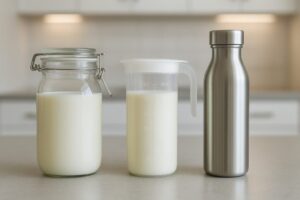
- How to heat up breast milk on the go: Use a high-quality, insulated thermos filled with hot water. When you need to warm a bottle, simply place the sealed bottle inside the thermos for 5–10 minutes. This provides a portable water bath. Always ensure the milk is used immediately after warming.
How Long Does Reheated Breast Milk Last?
Milk that has been warmed, chilled, and then brought up to feeding temperature again is classified as reheated milk. U.S. health authorities strongly advise against this.
- Can I heat breast milk twice? No. Each warming cycle dramatically accelerates bacterial growth and degrades the anti-infective properties. The cumulative risk after secondary heating is too high.
- Can you put heated breast milk back in the fridge? Generally, no. While some guidelines permit re-chilling unused warmed milk (with no mouth contact) and using it within 24 hours of the first warming, you must never reheat it again. The safest practice is to discard any milk that was warmed and not used instantly.
- Can I freeze heated breast milk? No. Once milk has been heated, it must never be frozen again. Freezing, thawing, and heating cause structural changes that make repeated freezing unsafe.
👉 For the exact warming method, follow our detailed guide: How Do You Warm Up a Bottle of Breast Milk? (Safe, Step-by-Step Guide 2026).
Most Common Questions About Heated Breast Milk
We know parents have dozens of questions about the safety clock. Here are quick answers to some of the most pressing questions about heated milk:
Q: Can I heat breast milk?
A: Yes. You can heat breast milk gently using a warm water bath or a bottle warmer set to a low temperature.
Q: Can you heat breast milk in microwave?
A: No. Microwaving creates dangerous hot spots that can scald your baby and severely destroys protective nutrients and antibodies.
Q: Can I heat breast milk twice?
A: No. It is strongly discouraged. Reheating breast milk that has already been warmed once significantly increases microbial and nutrient degradation risks.
Q: What is the best way to heat breast milk?
A: The best way is using a warm water bath (bowl of warm tap water) or a quality electric bottle warmer.
Q: Can I mix warm and cold breast milk?
A: No. You must cool the freshly expressed breast milk completely in the refrigerator before mixing it with older, chilled milk.
Q: What temperature should breast milk be heated to?
A: The ideal temperature is between $98^{\circ}\text{F}$ and $104^{\circ}\text{F}$ ($37^{\circ}\text{C}$ and $40^{\circ}\text{C}$).
Q: Can I freeze heated breast milk?
A: No. Once breast milk has been heated, it should not be frozen again. Use it immediately or discard it.
Q: How long can previously frozen breast milk sit out after being heated?
A: Once thawed breast milk is heated, the safety window is strict: use it within 2 hours at room temperature, then discard.
Conclusion
The safest rule for U.S. parents regarding how long can heated breast milk sit out is simple: 4 hours maximum for freshly warmed milk, and a strict 2 hours for leftovers.
By following these CDC-backed time limits, always using gentle heating methods, and warming small portions to minimize waste, you confidently maintain the highest safety standards for your baby. Remember that while the guidelines may seem strict, they are designed to protect the fragile components of your milk and your baby’s health.
For complete guidance, visit our main breast milk storage guide and warming guide linked above.