Skip to content
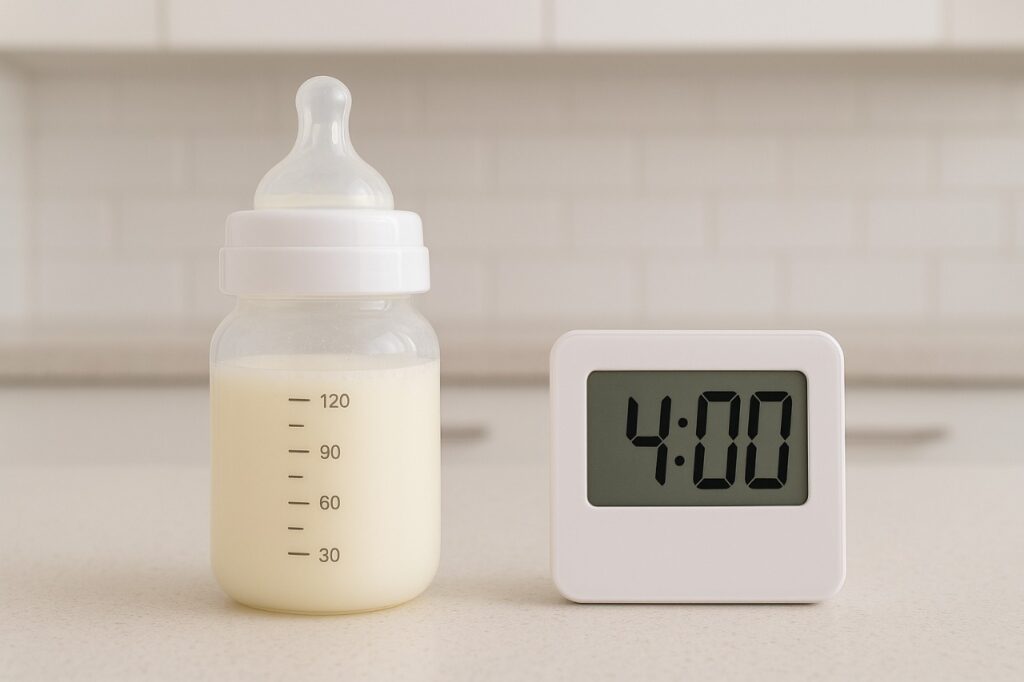
If you’ve ever pumped milk and left it out on the counter, you’ve probably asked yourself, “How long is this still safe for my baby?”
For many U.S. parents juggling work, errands, or late-night feedings, knowing the exact time limits is essential. It’s not just about convenience; it’s about keeping your baby healthy while making every drop count.
This guide breaks down everything you need to know about room temperature safety, covering freshly pumped breast milk, thawed milk, and even milk that has already been warmed or used. We rely on strict CDC-recommended time limits to ensure maximum protection for your baby.
💡 Quick Summary: The Essential Room Temperature Rules
- Freshly Pumped Milk: Safe for 4 hours (up to 77°F / 25°C). Reduce this to 2 hours in warmer climates.
- Thawed Milk: Once completely defrosted, use or discard within 1 to 2 hours at room temperature.
- Warmed or Reheated Milk: Use immediately or discard within 1 to 2 hours after warming. Never rewarm it twice.
- Used/Finished Feeding: Discard any remaining breast milk within 1 hour of the baby starting to feed, as saliva introduces bacteria.
- Overnight: Breast milk should never be left out overnight.
How Long Can Pumped Breast Milk Stay at Room Temperature? (CDC-Based Guide)
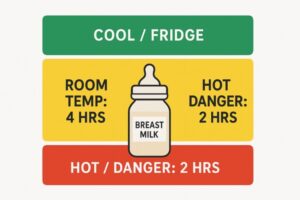
The “4-Hour Rule” is the standard guideline. This applies to breast milk that is freshly expressed and has never been warmed or fed to the baby.
According to the Centers for Disease Control and Prevention (CDC), freshly expressed breast milk can safely remain at room temperature (up to $77^{\circ} \text{F} / 25^{\circ} \text{C}$) for up to 4 hours.
Here’s the general breakdown depending on the ambient temperature:
- Room temperature under $77^{\circ} \text{F}$ ($25^{\circ} \text{C}$): Safe for up to 4 hours.
- Warm climate (above $80^{\circ} \text{F}$ / $27^{\circ} \text{C}$): Reduce the safety window to 2 hours maximum.
- Cool indoor temperature (around $68^{\circ} \text{F}$ / $20^{\circ} \text{C}$): Some sources suggest up to 6 hours. However, the safest practice is always to use or refrigerate the breast milk within 4 hours.
👉 If you’re unsure about your room’s temperature, always follow the strictest 4-hour rule. For official data, visit the 👉 CDC’s Human Milk Storage Guidelines.
Why Time and Temperature Matter So Much?
Breast milk contains natural enzymes and live antibodies that protect your baby. But once expressed, bacteria can multiply quickly at temperatures above 77°F (25°C), and valuable nutrients like lactoferrin and immunoglobulins begin to break down. That’s why timing matters: milk left out too long can lose both freshness and immune protection.
👉 Before continuing, check our detailed post on Can You Put Breast Milk Back in the Refrigerator? (Safety, Reuse & Storage Tips) to understand how temperature changes affect the breast milk quality.
How Long Can Breast Milk Stay at Room Temperature After Feeding?
Once your baby’s mouth touches the nipple of the bottle, the rules change immediately due to the introduction of bacteria from the baby’s saliva.
Rule: Breast milk that a baby has partially drunk from should be used or discarded within 1 to 2 hours after the feeding session ends.
- Discard, Don’t Refrigerate: Never return milk that your baby has already partially consumed back into the refrigerator. The bacterial load is too high to be safely stored again.
- Safety Priority: This is the shortest time window because the potential for bacterial contamination is the highest.
How Long Is Thawed Breast Milk Good at Room Temperature?
Thawed (defrosted) breast milk has a much shorter shelf life than fresh milk, even at room temperature. This is because the freezing process may initiate the breakdown of some fat-digesting enzymes.
Rule: Once frozen breast milk is completely thawed, it can remain at room temperature for no more than 1 to 2 hours.
- Freezer to Fridge First: Ideally, breast milk should be thawed in the refrigerator overnight. Once thawed in the fridge, it is good for 24 hours.
- Thawing at Room Temp: If thawing happens at room temperature, it must be used immediately, and should never be put back into the freezer.
How Long Can Warmed Breast Milk Stay at Room Temperature?
Warming breast milk speeds up bacterial growth. Therefore, any milk that has been warmed even if it was done gently in a bowl of warm water—must be treated with extreme caution.
Rule: Warmed breast milk should be used within 1 to 2 hours after warming.
- Never Rewarm: The general safety rule is to never rewarm breast milk a second time. If the baby doesn’t finish it within the 2-hour window after warming, discard the remainder.
How Long Can Reheated Breast Milk Stay at Room Temperature?
The terms “warmed” and “reheated” often mean the same thing in common usage, but the safety guideline is clear: Breast milk should only be heated once.
If, however, the milk was only slightly warmed, cooled, and then warmed again (which is discouraged), the safety window remains extremely strict: use immediately or discard within 1 hour.
How Long Can Breast Milk Stay at Room Temperature Overnight?
Answer: No. Breast milk should never be left out at room temperature overnight.
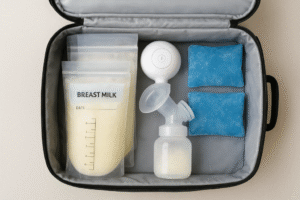
Even in a cool room, leaving breast milk out for more than the recommended 4 hours drastically increases the risk of serious bacterial growth, making it unsafe for your baby. Always use a cooler bag with ice packs for overnight storage or travel.
How to Know When Milk Is No Longer Safe?
Even if your milk looks fine, subtle signs can indicate spoilage. Here’s what to watch for:
- Smell: A sour, soapy, or rancid odor. (Note: Soapy smell can be from Lipase, which is safe but you must still follow the time rule.)
- Texture: Fat separation that doesn’t mix after gentle swirling, or a visibly curdled/clumped texture.
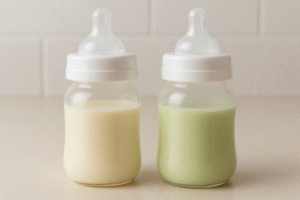
- Color: An unusual color turning grayish or visibly curdled discard immediately.
What to Do If Milk Has Been Out Too Long?
If milk has been left out for longer than the recommended time limit (e.g., over 4 hours for fresh milk, or over 2 hours for thawed/warmed milk), discard it immediately. Do not mix it with fresh milk or refrigerate it again.
Golden Rule: “When in doubt, throw it out — don’t risk it.”
Practical Storage Tips for Room Temperature Safety
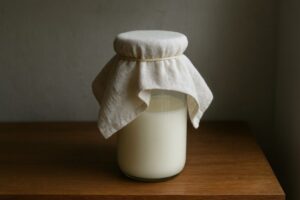
- Keep milk in a shaded, cool area: Avoid direct sunlight, window sills, or near stoves.
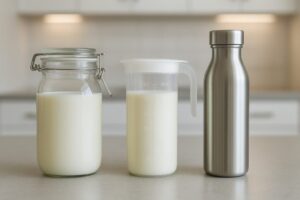
- Use smaller bottles: Store breast milk in 2–4 oz portions to reduce waste.
- Cover the container tightly: Prevents airborne contamination.
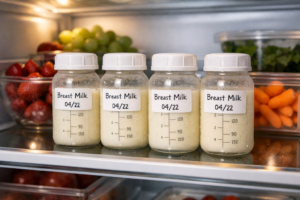
- Label with time: Always note when the breast milk was pumped — start counting from that moment.
- Insulated Coolers: With ice packs, milk can last up to 24 hours safely, according to the CDC.
👉 Learn more about handling breast milk while traveling in our guide How to Store Breast Milk on the Go? (Portable Storage Safety Guide).
Common Questions About Breast Milk Stay at Room Temperature
Q: What is the maximum safe temperature for breast milk at room temperature?
A: The absolute maximum safe temperature is $77^{\circ} \text{F}$ ($25^{\circ} \text{C}$), as established by the CDC. If the room temperature goes above this, the safe storage time must be immediately reduced from 4 hours to 2 hours (or less).
Q: My breast milk smells soapy after sitting out—is it spoiled?
A: Not necessarily. This is usually due to Lipase activity, a natural enzyme breaking down fat, not bacterial spoilage. However, this milk must still be discarded if it has been out longer than the safe 4-hour limit, as the time and temperature rule always overrides the smell/taste.
Q: Does the “4-hour rule” apply to all human milk, including donor milk?
A: Yes. The CDC guidelines are based on human milk in general. For donor milk, always follow the specific instructions provided by the milk bank. If you take it out, the 4-hour room temperature rule is the safest guideline to follow.
Q: What is the risk of using breast milk left out for 6 hours?
A: The risk is high. After the 4-hour mark, the rate of bacterial growth increases exponentially. Using breast milk left out for 6 hours or more significantly raises the risk of gastrointestinal illness or infection for your baby. It is safest to discard it.
Q: What if I stored breast milk in an insulated bag?
A: With ice packs, breast milk can last up to 24 hours safely, according to the CDC.
Conclusion: Safe Timing Protects Your Baby and Your Peace of Mind
Understanding the exact rules for room temperature storage is the key to minimizing waste and maximizing safety for your baby. Breast milk is dynamic, and its safe life span changes drastically depending on how it has been handled:
4 Hours: This is the gold standard for freshly pumped breast milk (under 77°F). Treat this as the absolute maximum.
1–2 Hours: This is the stricter limit for thawed, warmed, or reheated milk, as the protective structure of the milk has already been altered.
Immediate Discard: Milk that has been partially consumed by the baby must be discarded quickly due to bacterial risk.
👉 By strictly adhering to these time limits provided by the CDC, U.S. parents can confidently ensure their “liquid gold” remains nutrient-rich, safe, and ready for every single feed.