Skip to content
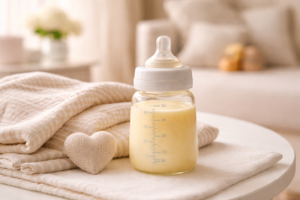
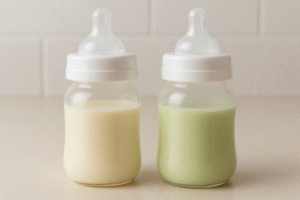
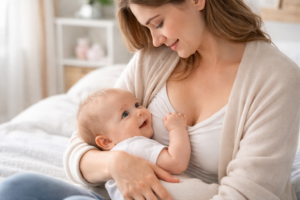
For U.S. parents, safely warming breast milk is an essential feeding skill that protects its nutritional value and vital immune factors. When done correctly, warming ensures the milk retains its beneficial enzymes and is the perfect temperature for your baby. When done incorrectly (like microwaving or overheating), you risk destroying these protective components and creating hot spots.
👉 This step-by-step guide covers the safest methods and essential temperatures, ensuring you know exactly how to warm up a bottle of breast milk safely from the fridge or freezer. For foundational storage rules, see the official CDC guideline, CDC Breast Milk Storage Guidelines.
What You Will Learn in This Warming Breast Milk Guide
- The step-by-step instructions for safely warming breast milk using the gentle water bath method.
- The ideal temperature range ($\mathbf{98^{\circ}\mathbf{F}}$ to $\mathbf{104^{\circ}\mathbf{F}}$) to preserve nutrients.
- The safe alternatives for heating milk when traveling or away from home.
- Critical methods to avoid (Microwaving, boiling) that destroy antibodies.
- The strict time limit (2 hours) for using warmed milk after feeding starts.
🌡️ The Ideal Temperature and Goal
The goal is to gently bring the milk to body temperature ($98^{\circ}\text{F}$ to $104^{\circ}\text{F}$ / $37^{\circ}\text{C}$ to $40^{\circ}\text{C}$). This warmth helps preserve the milk’s active ingredients and ensures your baby accepts the feed comfortably.
Step-by-Step Guide: The Warm Water Bath Method (Best Practice)
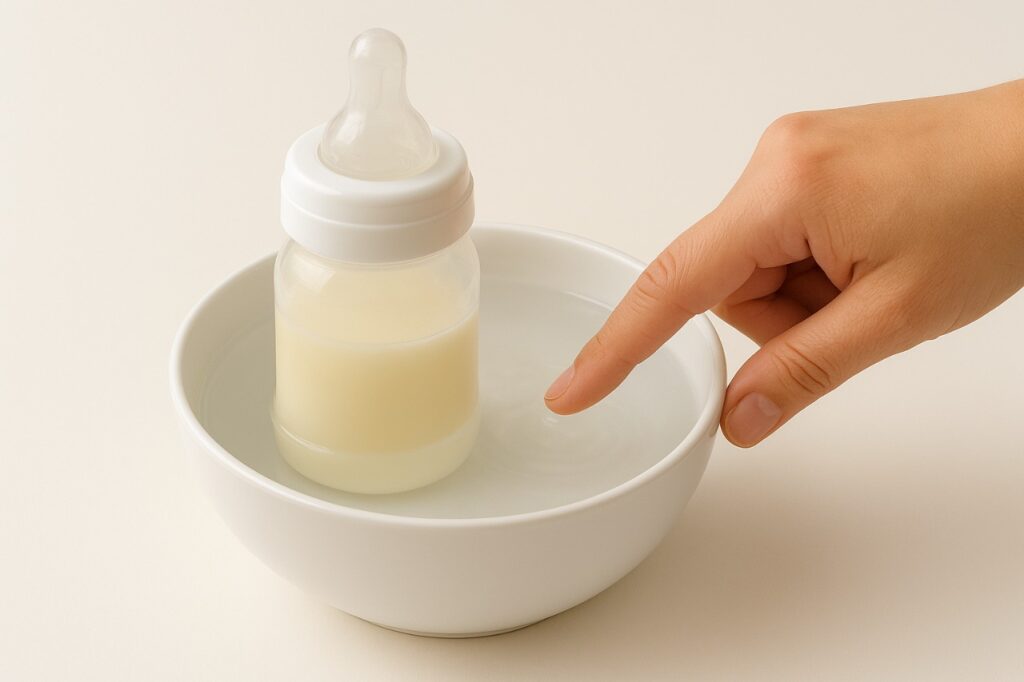
The warm water bath is considered the gold standard for gently warming breast milk, especially when you need to heat breast milk from refrigerator storage.
1. Prepare the Breast Milk (Swirl, Don’t Shake)
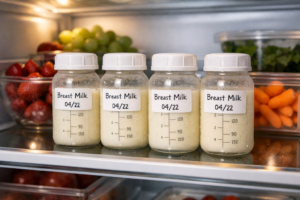
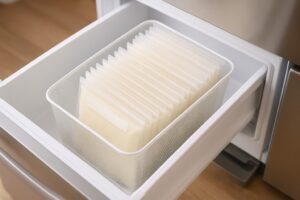
- Remove the necessary portion (2–4 ounces) of milk from the fridge or freezer.
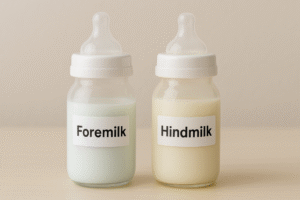
- Swirl gently: If the fat has separated and settled at the top, gently swirl the bottle or bag to mix it evenly. Do not shake vigorously, as this can damage proteins and enzymes.
2. Set up the Gentle Water Bath
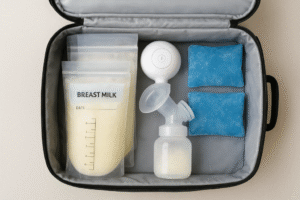
- Fill a bowl or mug with warm (not boiling) tap water. The water should feel warm to your hand but not painfully hot.
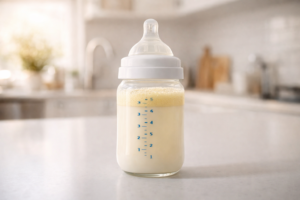
- Place the sealed bottle or storage bag into the warm water bath. Ensure the water level is below the cap or seal.
- Allow the milk to sit for 5 to 10 minutes. The goal is a gradual temperature change.
3. Test and Feed Immediately
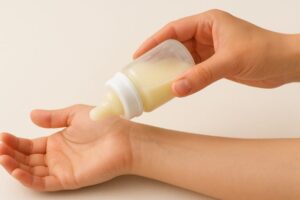
- Remove the bottle from the water and dry the exterior.
- Test the temperature by dropping a few drops onto your wrist. It should feel comfortably warm, not hot.
- Feed immediately. The safety clock starts now.
👉 For deeper safety rules, read this complete resource: How Long Can Heated Breast Milk Sit Out? (CDC Safety Guide 2025).
Alternative Safe Methods and Equipment
If you need to heat breast milk bottle quickly or while away from home, these alternatives are safe, provided they use low, consistent heat.
Using a High-Quality Bottle Warmer Safely
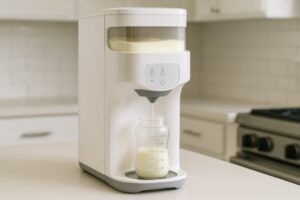
- Choose a warmer that uses steam or a constant warm water circulation system, not dry heat.
- Use a low setting or a setting specifically designed for breast milk (often labeled $37^{\circ}\text{C}$).
- Never leave the bottle in the warmer for extended periods after it reaches temperature.
Warming Breast Milk On-the-Go (Travel Method)
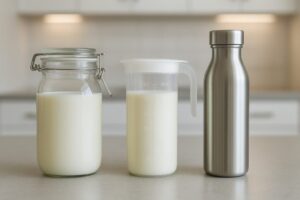
- How to heat up breast milk on the go: Use an insulated thermos. Fill it with pre-heated hot water before leaving home.
- When needed, place the sealed bottle into the thermos water for a few minutes. This serves as a portable warm water bath.
Critical Warnings: Methods to NEVER Use
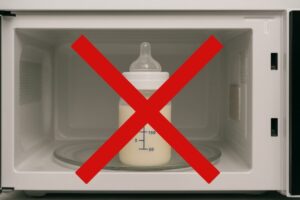
To protect your baby’s health and the milk’s quality, avoid these common shortcuts.
Why Microwaving and Boiling Water Are Dangerous?
- Microwaves: Never use a microwave to warm breast milk. Microwaving creates hot spots that can severely burn a baby’s mouth, and the rapid, high heat destroys essential antibodies and nutrients.
- Boiling Water / Stovetop: Do not place the bottle directly on a stove or use boiling water. Extreme heat degrades the breast milk’s beneficial properties and can cause curdling.
👉 For safe feeding practices, review trusted breast milk guidance from the American Academy of Pediatrics: AAP Breastfeeding & Bottle Safety Tips.
Optimal Temperature and Post-Warming Use
The Ideal Feeding Temperature Range
The target temperature (approx. $98^{\circ}\text{F}$ to $104^{\circ}\text{F}$) is necessary because heating beyond this range compromises the milk’s structure. The best indication is when the drop on your wrist feels neither hot nor cold.
How Long to Use Warmed Breast Milk? (Quick Safety Note)
Once breast milk is warmed to feeding temperature, it is essential to use it quickly to prevent bacterial growth.
- After warming, use the milk within 2 hours. This includes any milk left over in the bottle after feeding begins.
- Do not re-warm: Never reheat milk that has cooled down or been previously warmed.
👉 For precise time limits, rules on reheating, and the 4-hour exception, you can read our complete guide here: How Long Does Breast Milk Last? (Complete USA Guide 2025).
Most Common Questions About Warm Up Bottle of Breast Milk
Q: Can I mix warm breast milk with cold milk?
A: No. Cool the freshly expressed milk completely in the refrigerator before mixing it with older, chilled milk.
Q: How do you heat frozen breast milk?
A: Thaw it fully in the refrigerator first, or use the quick warm water bath method mentioned above.
Q: What is the fastest safe way to heat breast milk?
A: A warm water bath or a high-quality bottle warmer set to a low temperature.
Q: Can I heat breast milk in boiling water?
A: No. Boiling water destroys nutrients and can overheat the breast milk.
Conclusion
Safely warming breast milk is a balance of patience and temperature control. By using gentle methods like the warm water bath, avoiding harsh heat sources, and feeding promptly, you ensure every drop retains its safety and optimal nutrition for your baby.
👉 For details on safety time limits and exceptions, read our full guide: How Long Can Heated Breast Milk Sit Out? (CDC Safety Guide 2026).