Skip to content
Reduced-fat dairy choices have become increasingly popular in the United States due to their balanced texture, structural nutrients, and lower caloric load. But when managing a household diet, one question every consumer asks is simple: what are the actual 2% cow milk nutrition facts? The answer depends on the manufacturing fat-separation standards, commercial fortification metrics, and the exact liquid volume you consume in your daily routine.
In this comprehensive guide, we’ll explore the exact macronutrient distribution of 2% reduced-fat cow milk, analyze its liquid calorie conversions across multiple standard measurements, and share official U.S. nutritional insights from the FDA and USDA.
What You Will Learn in This Guide
The exact breakdown of 2% cow milk nutrition facts per standard serving.
Complete liquid calorie calculations from a single ounce up to one full liter.
Official U.S. nutrient labeling guidelines from the FDA and USDA.
How the unique fat content and lipid percentages alter the total nutritional value of cow milk.
Safe ways to track your daily macro intake without risking commercial dairy overlapping.
👉 If you want to learn whether traditional dairy products fit your long-term wellness goals, read our detailed guide on is cow milk good for you to explore its holistic benefits.
Quick Answer: What Are the 2% Cow Milk Nutrition Facts? (Nutrients at a Glance)
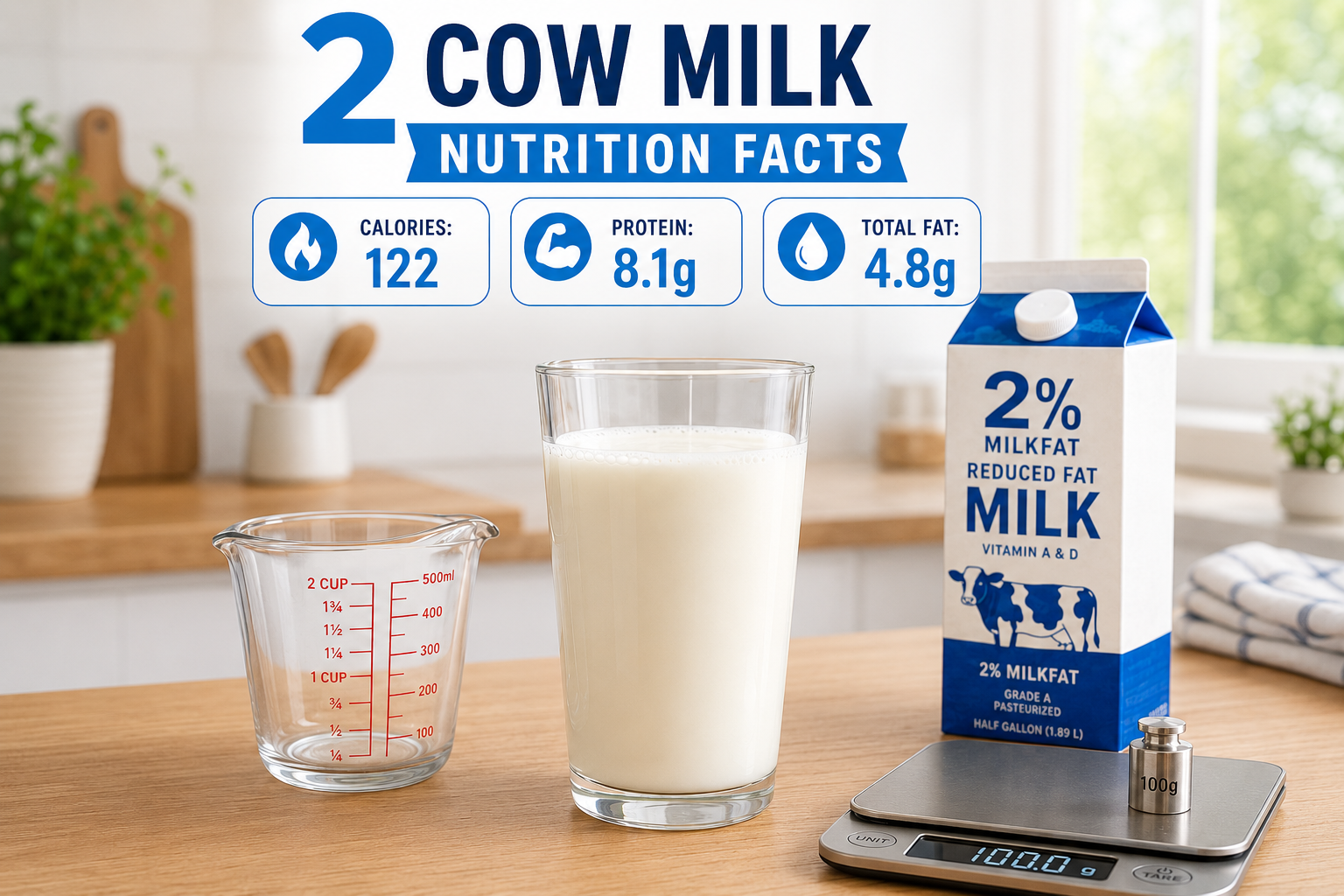
In general, 2% reduced-fat cow milk provides a precise nutritional middle ground between heavy whole dairy and completely fat-free skim liquids. A standard 1-cup serving of 2% cow milk delivers approximately 122 calories, 8 grams of high-quality protein, and 12 grams of naturally occurring lactose sugars. The primary defining factor is its fat content, which is mechanically standardized to represent exactly 2% of the total milk weight, resulting in 4.8 grams of total lipids per cup.
According to the United States Department of Agriculture, reduced-fat 2% milk provides a balanced combination of protein, calcium, and essential nutrients while containing less fat than whole milk varieties.
👉 For proper kitchen placement, cold storage containment, and sensory freshness timelines, read our full guide on how long does cow milk last.
What Does 2% Reduced-Fat Cow Milk Actually Mean?
Most store-bought dairy products in the United States undergo mechanical separation to adjust their natural lipid levels. When analyzing the nutritional value of cow milk, many consumers assume “2% milk” means the beverage is 98% fat-free by weight, which is correct, but it does not mean 2% of the total calories come from fat.
Understanding Cow Milk Fat Content and Percentages
The raw fluid drawn from dairy herds typically carries a higher lipid profile, varying by breed. For instance, the traditional jersey cow milk fat content is naturally much higher, often exceeding 5% total lipids. To create standard commercial low fat cow’s milk, processing plants use industrial centrifuges to separate the cream from the liquid.
Once the cream is removed, technicians precisely add fat back into the batch to meet the legal definition of low fat cow milk nutrition. According to U.S. commercial definitions, 2% reduced-fat milk has had a significant portion of its original cream removed, leaving a standardized cow milk fat percentage of exactly 2% of the total liquid weight.
As noted by the USDA, the structural standardization of low-fat dairy ensures that consumers receive a consistent protein-to-lipid ratio in every carton, regardless of seasonal farming shifts.
2% Cow Milk Nutrition Facts: Complete Nutrient Breakdown
To build an accurate cow milk nutrition chart, we must look closely at the exact macro and micro components found inside a standard 1-cup reference serving (approximately 244 grams) of pasteurized 2% reduced-fat dairy.
Baseline Macronutrient Profile
For a quick reference, a single 1-cup (244g) serving of 2% cow milk delivers a highly balanced distribution of core energy metrics and foundational lipids:
| Core Nutrient Component | Measurement Value | Key Structural Element |
| Total Energy | 122 Calories | Metabolic Daily Fuel |
| Total Protein | 8.1 grams | 80% Casein / 20% Whey Protein |
| Total Milk Fat | 4.8 grams | Includes 3.1g Saturated Fat |
According to the United States Department of Agriculture, reduced-fat milk products supply essential nutrients like protein, calcium, potassium, and vitamin B12 while lowering saturated fat compared to whole milk.
Calories and Macronutrients
When analyzing cow milk nutrition facts, the caloric density is the first metric to monitor. A standard single cup of 2% reduced-fat dairy contains exactly 122 calories. How cow milk calories come down to this number depends entirely on its structural combination of protein, carbohydrates, and residual milk fats:
Protein (8.1 grams): Highly bioavailable protein consisting of 80% solid casein and 20% liquid whey, containing all essential amino acids necessary for physical tissue repair.
Carbohydrates (12 grams): Derived entirely from natural milk sugar known as lactose, which provides steady metabolic energy without the sudden spikes associated with cane sugars.
Total Fat (4.8 grams): The structural lipid layer that gives the liquid its smooth texture. The cow milk fat content in this specific product includes 3.1 grams of saturated fat, 1.3 grams of monounsaturated fat, and minor traces of naturally occurring ruminant trans fats.
According to the USDA FoodData Central database, reduced-fat 2% milk naturally contains protein, lactose carbohydrates, and milk fats that contribute to its overall caloric value and nutritional profile.
👉 Maintaining these nutritional qualities also depends heavily on proper refrigeration practices, which is why many families explore guides like how to store cow milk for better freshness management.
Vitamins and Mineral Fortification
The underlying cow milk nutrition label reveals that reduced-fat dairy is an exceptional source of essential micronutrients. Because removing natural cream also extracts fat-soluble vitamins, U.S. processors routinely fortify 2% dairy to elevate its nutritional value:
Calcium: Delivers 30% of your daily value ($DV\%$), supplying essential structural support for skeletal density and dental strength.
Vitamin D: Typically fortified to supply 25% of your $DV\%$, which directly enhances your digestive tract’s ability to absorb calcium efficiently.
Vitamin B12: Naturally provides over 50% of the adult $DV\%$, helping to sustain healthy neurological function and red blood cell production.
👉 For structural freezing guidelines and container safety methods that protect these delicate micronutrients from cold degradation, read our complete guide on can you freeze cow milk.
The Ultimate Weight-Based Volume Calorie Calculator
To help you track your exact daily intake, we have converted the official USDA cow milk calories across every common fluid volume and kitchen measurement used in modern meal planning.
Liquid Conversions: From Ounces to Liters

Because density alters how many calories in cow milk are consumed, utilizing a standardized volume table prevents common logging errors. The total energy output scales linearly based on the fluid weight.
Here is a quick table based on official USDA nutritional data for 2% reduced-fat cow milk:
| Fluid Volume / Metric | Total Caloric Output | Primary Nutrient Focus | Action Required |
| Cow milk calories per ounce | 15.2 Calories | Traces of lipids per fluid oz | Best for logging minor recipe splashes |
| 100 ml cow milk calories | 50 Calories | 3.3g Carbs / 2g Fat / 3.3g Protein | Standard metric baseline measurement |
| Calories in 200 ml cow milk | 100 Calories | 6.6g Carbs / 4g Fat / 6.6g Protein | Common small retail carton size |
| 250 ml cow milk calories | 125 Calories | 8.2g Carbs / 5g Fat / 8.2g Protein | Equal to one metric breakfast serving |
| Calories in 300 ml cow milk | 150 Calories | 10g Carbs / 6g Fat / 10g Protein | Typical individual workout shake base |
| 500ml cow milk nutrition | 250 Calories | 16.5g Protein / 10g Lipids | Half-liter intense macro recovery target |
| 1 cup cow milk calories | 122 Calories | 8.1g Protein / 4.8g Fat | Standard U.S. FDA kitchen serving size |
| 1 glass cow milk calories | 152 Calories | ~10g Protein / 6g Fat | Based on a standard 10-ounce tumbler |
| 1 litre cow milk calories | 500 Calories | 33g Protein / 20g Total Fat | Full family bulk container consumption |
Warning Note: These specific caloric measurements apply strictly to standard, pasteurized 2% reduced-fat commercial dairy. If your household consumes unaltered raw farm liquids, or heavy whole dairy options like jersey cow milk nutrition facts, the total lipid counts and energy metrics will be significantly higher.
👉 Flavor perception can also shift slightly depending on fat concentration and serving temperature, which is one reason many readers compare profiles in guides like what does cow milk taste like.
Domestic Processing Alterations: Boiled vs. Fortified Dairy

Many health-conscious households practice traditional boiling methods before serving commercial beverages to their families. Understanding how domestic heat affects boiled cow milk nutrition is essential for accurate nutrient tracking.
Nutritional Transitions During Heat Application
Subjecting pasteurized 2% dairy to structural boiling does not alter the core macronutrients or eliminate the underlying cow milk calories. The protein, carbohydrate, and fat levels remain stable under standard kitchen temperatures. However, prolonged exposure to high heat can degrade certain water-soluble micronutrients, particularly vitamin B12 and thiamin.
Additionally, standard boiling causes a minor loss of water volume through steam evaporation. This concentration slightly increases the nutrient density per remaining ounce, though the overall nutritional value of cow milk within the entire pot stays relatively uniform.
According to official FDA nutrition labeling guidelines, consumers should rely on the raw packaged label metrics for dietary planning, as domestic home boiling causes negligible macro shifts compared to commercial industrial pasteurization.
Beyond 2% Dairy: Protecting Your Future Content Rotations

To ensure your family’s systemic health management remains perfectly clear, it is crucial to recognize where 2% reduced-fat milk stands compared to other specialized farm liquids.
While 2% milk cuts down the lipid profile to provide a balanced daily beverage, those looking for unaltered, full-fat creamy assets should explore our upcoming deep-dive on whole milk nutrition.
Conversely, for an option that eliminates these remaining 4.8 grams of fat entirely to support strict low-calorie cutting goals, stay tuned for our analytical breakdown on skim milk nutrition.
Why Trust Fooder Ghor?
At Fooder Ghor, we provide educational resources focused on understanding the safe use, handling, and storage of different types of milk, including breast milk, cow’s milk, goat milk, and raw milk, based on publicly available guidance from trusted sources such as the CDC, FDA, USDA, and AAP. Some milk-related articles, particularly those involving maternal and infant feeding topics, are reviewed for clarity and presentation by nursing students with academic training in maternal and child health to help make information easier to understand. This content is provided for learning purposes only and does not offer medical advice.
Most Common Frequently Asked Questions
A. No. The 12 grams of carbohydrates displayed on the 2% cow milk nutrition facts label come entirely from natural lactose sugars. No refined cane sugars or corn syrups are added during standard commercial milk processing.
A. When dairy plants separate natural cream to lower the cow milk fat content, vital fat-soluble vitamins are lost. The FDA requires fortification to restore these nutrients, ensuring the beverage maintains its traditional public health value.
A. No. Heating or warming the liquid does not change its chemical calorie value. A 200 ml serving of 2% milk will consistently supply 100 calories, whether it is served ice-cold or heated on a stovetop.
A. Under U.S. regulatory guidelines, 2% dairy is classified specifically as “reduced-fat” because it still retains 4.8 grams of lipids per cup. To be legally labeled as true “low-fat,” a beverage must contain 1% or less total fat content.
A. No. Calcium is an elemental mineral that is entirely heat-stable. Boiling your dairy to prepare family meals will not destroy, alter, or diminish the structural value of the calcium present in the liquid.
Conclusion
So, what are the core 2% cow milk nutrition facts? That depends entirely on standardized serving volumes. A baseline 1-cup serving of 2% reduced-fat cow milk delivers a balanced 122 calories, 8.1 grams of muscle-building protein, and a controlled 4.8 grams of animal fats. By tracking your consumption across specific volumes—whether logging a small 100 ml dash or a full 1-liter meal preparation—you can safely optimize your family’s macro targets. Always reference certified nutritional labels and utilize proper kitchen metrics to maintain complete control over your daily dairy rotation.
👉 If you also want to compare plant-based alternatives and their nutritional profile, you can read our guide on coconut milk nutrition.